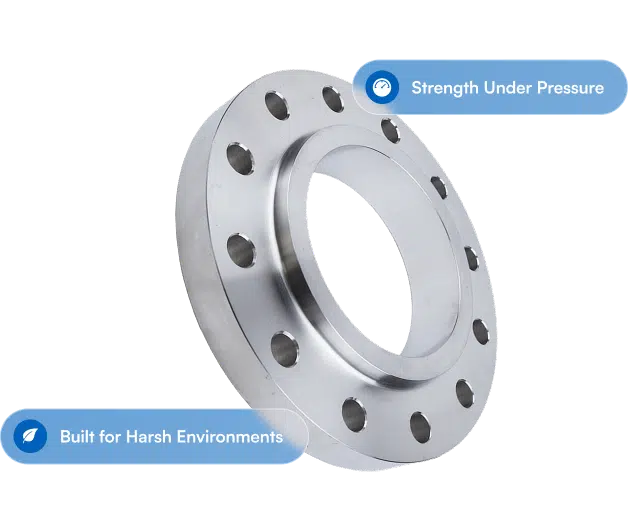
ANSI Flanges
What Is ANSI?
ANSI stands for American National Standards Institute, a non-profit organization that supports the technology development standards in the United States. The primary objective is to foster consistency, interoperability, and quality across many industries within the United States.
ANSI serves as a connecting link between different industry experts, governmental bodies, and private enterprises. It recognizes and supports standards development in alliance with industry and government stakeholders. It provides a platform for creating, revising, and approving standards that cover various sectors, from technology and manufacturing to healthcare and beyond.
One of the outstanding contributions of ANSI is to create standards for flanges. Flanges are crucial for joining pipes and equipment in various industrial settings. ANSI establishes a comprehensive standard for flange specifications, ensuring these components’ compatibility and safety across diverse applications. These standards encompass flange dimensions, materials, pressure ratings, and testing procedures.
The ANSI’s role has become evident when considering the diverse applications of flanges in many industries, such as chemical plants, oil refineries, power generation facilities, and water treatment plants. Without standardized guidelines, each sector might develop its ad-hoc specifications, which lead to inefficiencies, increased costs, and potential risks.
ANSI Flanges That Suit Your Project’s Requirements
Slip-On Flanges
Slip-on flanges have a hub with a low profile. They have a bigger internal diameter as compared to the pipe's diameter. Due to this trait, the slip-on flange easily slips onto the pipe. These flanges are sometimes unsuitable for high-pressure scenarios, as their lack of neck which can improve the joint's strength. Call out example 6” 150# RFSO 304L
Weld Neck Flanges
A weld neck flange, which has a tapered hub, minimizes stress concentration by transferring stresses to pipes. Weld Neck flanges have internal diameters that match the schedule of what they are being welded to. A weld neck flange is the right fit for high pressure and temperatures, lessening erosion and turbulence. Call out example 4” 1500# RTJWN Sch160 Bore A105
Blind Flanges
Blind flanges provide a solid barrier to seal the end of a pipe. This design prevents the passage of fluids or gasses, allowing for testing and/or capping off lines. Blind flanges come into play in many applications, such as hazardous material transport or system maintenance. Blind flanges have an essential role in separating pipeline sections, ensuring workers' safety, and facilitating necessary maintenance tasks. Call out example 30” 300# RFBlind Ser A 316H
Lap Joint Flanges
Lap joint flanges are well-known as backup flanges, loose ring flanges, loose hubbed flanges, and van stone flanges. This flange type has two parts: a lap joint stub end and a backing lap joint flange. Lap Joint Stub End is a butt welded fitting that is welded to the pipe, and a backing lap joint flange slid onto the pipe before welding the Stub End. Call out example 2” 150# LJ A105
Threaded Flanges
Threaded flanges contain internal threads, allowing them to screw onto the pipe. It alleviates the need for welding, making them fit for small-diameter pipes or areas where welding might be difficult. However, threaded connections need more robustness and are usually best for lower-pressure environments. This flange usually is used with smaller pipes. Call out example 1 1/2” 300# FFThrd 2205
Socket-Weld Flanges
Socket weld flanges are similar to slip-on flanges but with a little twist. These flanges have a compact size and leakage-free feature. The pipe flanges are connected by inserting the pipe into the socket end and using a fillet weld around the top. Call out example 8” 150# RFSW XH Bore A105
Industries We Serve
ANSI Flanges Engineered For Excellence
Food Processing And Manufacturing
Waterworks And Municipal Pipe Systems
We take pride in catering to unique business needs and making their industrial applications smooth, efficient, and seamless.
Food Processing and Manufacturing industries have regular use of ANSI flanges. Common applications include connecting pipes in dairy production, beverage processing, and bakery operations. In manufacturing, flanges link various components in machinery and equipment assembly, aiding easy maintenance and repairs. In both sectors, flanges ensure efficient operations and compliance with quality standards, making them indispensable components.
ANSI Flanges, along with AWWA flanges, ensure robust connections for efficiently transporting and distributing water and other fluids. Flanges connect pipes that carry treated water to storage tanks and distribution networks in water treatment plants. Municipal pipe systems utilize flanges to connect varying-sized pipes, facilitating water supply to residential, commercial, and industrial areas.


Valves, Vessels, And Industrial Pumps
Heating Systems And Heat Exchangers
Flanges are essential in the valves, vessels, and industrial pumps industry, ensuring reliable and secure connections. In valves, flanges connect pipes to control fluid flow, making them vital for oil, gas, and water distribution pipelines. Vessels, such as tanks and reactors, use flanges to attach pipes for filling, emptying, and monitoring processes in industries like chemical manufacturing. Industrial pumps often require flanges to connect inlet and outlet pipes, enabling efficient transfer of liquids in sectors like mining and wastewater treatment.
Flanges support thermal energy's efficient transfer and regulation. In heating systems, flanges join pipes that circulate hot water or steam, ensuring reliable distribution to radiators or other heat emitters. Heat exchangers, essential in industries like HVAC and power generation, rely on flanges to connect fluid-carrying tubes, allowing heat exchange between different mediums.


Plumbing And Mechanical Systems
Fire Protection Services
In plumbing flanges connect pipes in water supply and drainage systems, preventing leaks and ensuring reliable fluid flow. They also connect fixtures like toilets, sinks, and showers to the plumbing infrastructure. Flanges connect components such as pumps, motors, and valves in mechanical systems, allowing easy maintenance and repairs.
Flanges attach pipes transporting water, foam, or other firefighting agents throughout a building or facility. Fire hydrants, sprinkler systems, and standpipes rely on flanges to create secure connections that can withstand high pressures during emergencies.


Power Plants And The Nuclear Power Industry
Oil, Gas, And Chemical Assemblies
Flanges are crucial in maintaining systems' safety, efficiency, and functionality in power plants and the nuclear power industry. They connect pipes in steam and water circuits, facilitating heat transfer and steam in power generation processes. They are crucial in connecting pipes that transport coolant in nuclear reactors, helping to regulate temperature and prevent accidents.
Flanges are indispensable in ensuring safe and efficient operations within complex assemblies in the Oil, Gas, and Chemical Industries. Flanges are extensively employed to connect pipes and equipment in various oil and gas extraction stages, transportation, and refining. Chemical plants utilize flanges to link pipelines carrying corrosive substances or hazardous chemicals, enabling controlled reactions and efficient material flow.


WHY CHOOSE US
Your ANSI Flange Journey Starts Here
Get a diverse range of industrial flanges with unparalleled strength and exceptional performance.