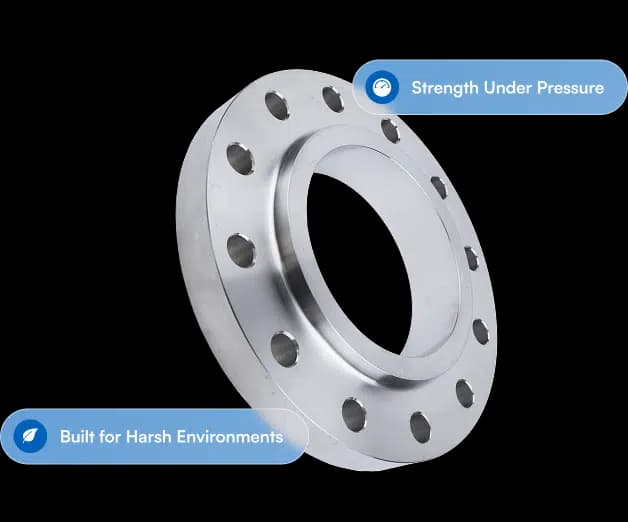
ASTM A105 Overview
ASTM A105 is a specification for carbon steel forgings used in piping flanges, fittings, and valves. It's the most economical choice for general industrial piping applications and is widely available from manufacturers worldwide. ASTM A105 specifies a steel with carbon content between 0.25% and 0.40%, manganese up to 0.90%, and small amounts of silicon, sulfur, and phosphorus. The result is a steel that's tough at room temperature and provides good mechanical properties up to approximately 400 degrees Fahrenheit.
The strength of ASTM A105 is adequate for the vast majority of industrial applications operating at ambient to moderate elevated temperatures. A Class 150 flange manufactured from ASTM A105 is more than sufficient for most piping systems. The material is economical because the chemical composition is simple, the forging process is straightforward, and worldwide supply is abundant. Essentially all piping flanges for general industrial service are ASTM A105.
ASTM A182 Overview
ASTM A182 is a specification for alloy steel forgings that includes numerous grades with different alloying elements and properties. Unlike A105, which is essentially a single material composition, A182 encompasses multiple materials identified by suffix letters (F1, F11, F22, etc.). Each grade has different chemical composition, strength, and temperature capability. Grade F1 (unalloyed) is similar to A105 but has slightly higher strength. Grades F11 and F22 contain chromium and molybdenum additions that provide enhanced high-temperature strength and corrosion resistance. Grades F304, F316, and F321 are austenitic stainless steels offering excellent corrosion resistance and high-temperature capability.
The diversity of A182 grades makes it suitable for a much wider range of applications than A105. A182 F22 is widely used for steam service where operating temperatures reach 1050 degrees Fahrenheit or higher. A182 F304 and F316 are stainless grades used in corrosive environments. The tradeoff is cost. A182 alloy grades are significantly more expensive than A105, sometimes 2-3 times the cost depending on the grade.
Key Differences
The most fundamental difference is temperature capability. ASTM A105 is suitable up to about 400 degrees Fahrenheit for continuous service, and some standards allow it to 600 degrees Fahrenheit with reduced pressure allowances. ASTM A182 F22 is suitable for service up to 1050 degrees Fahrenheit. This temperature range difference makes A182 mandatory for steam systems, furnace service piping, and other high-temperature applications.
Corrosion resistance is another major difference. A105 is plain carbon steel that will corrode in the presence of moisture and corrosive chemicals. A182 stainless grades (F304, F316) resist corrosion and are suitable for chemical service, seawater exposure, and food processing. The cost implications are significant. A carbon steel A105 flange might cost 30 dollars, while an equivalent A182 F316 stainless flange might cost 150 dollars or more. Material yield strength also differs. A105 and A182 F1 have similar yield strength, but higher alloy grades like F22 and F5 have superior strength at elevated temperature.
How to Choose Between Them
Start with the operating temperature. If the application operates below 400 degrees Fahrenheit continuously, ASTM A105 is appropriate and economical. If the application experiences occasional excursions above 400 degrees Fahrenheit but sustained operation is below 300 degrees, A105 is still suitable. If the application operates continuously above 400 degrees Fahrenheit, or if it's a steam service, specify ASTM A182 and select the appropriate grade for your temperature range.
Next, consider the fluid being piped. Water and common hydrocarbons are compatible with carbon steel A105 with appropriate corrosion allowance. Aggressive chemicals, seawater, or other corrosive fluids require A182 stainless grades. Compatibility tables published by ASME and in industry references provide guidance on material selection for specific chemicals.
Special Considerations
For cryogenic service (operating below minus 20 degrees Fahrenheit), neither standard A105 nor standard A182 is appropriate without special ordering. Impact properties at low temperature become critical, and you need low-temperature impact tested materials. ASTM A350 is the specification for low-temperature service flanges.
For sour service applications in oil and gas (hydrogen sulfide exposure), special material grades and heat treatment are required to prevent hydrogen embrittlement. Standard A105 and A182 are not appropriate without explicit sour service qualification. When specifying flanges for unusual service conditions, always consult with the flange manufacturer and your process engineer to ensure the selected material is appropriate. Failure to specify the correct material for extreme conditions can result in premature failure and safety hazards.