If you’ve quoted a flange order in the last six months and felt like the number didn’t match what you remember from 2023, you’re not imagining it. Three forces are stacked on top of each other right now: restructured Section 232 tariffs that hit in April, tightening BABA domestic-content thresholds, and post-pandemic raw material volatility that hasn’t fully unwound. Each one would move pricing on its own. All three together have rewritten what a flange costs and how long it takes to get one.
This is a working buyer’s brief on where things stand as of mid-2026. What changed, what it means for a quote, and what to do about it.
Section 232 Tariffs: The April 2026 Restructuring
Section 232 tariffs on steel and aluminum have been around since 2018, but the April 2, 2026 proclamation reshaped the regime in three ways that matter to flange buyers.
The rate went up. The headline rate on covered steel articles is now 50 percent, up from the prior 25 percent. Aluminum and most copper are at the same 50 percent. A reduced 15 percent transitional rate applies to certain metal-intensive industrial equipment through December 31, 2027.
The duty base expanded. As of April 6, 2026, the tariff applies to the full customs value of covered metal articles and derivatives, regardless of metal content. The old approach of paying duty only on the metal value of a finished article is gone. If the article is on the covered list, the whole landed value is in scope.
The 15 percent threshold cuts the other way. Products made of 15 percent or less steel, aluminum, or copper by content are no longer subject to Section 232. Anything above that threshold is in.
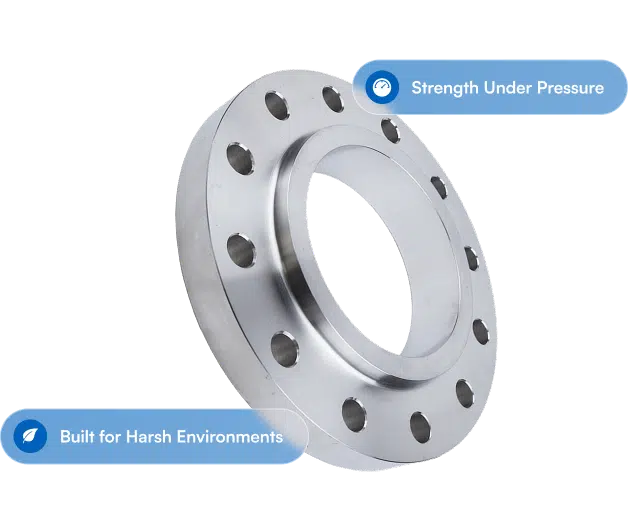
For flanges specifically, the answer is straightforward: a flange is steel. It’s well above 15 percent steel content. If it’s imported and on the covered list, it carries the 50 percent duty on full customs value. That’s a meaningful change from the prior structure.
What This Means for Imported Flange Pricing
The 50 percent rate on full customs value compounds quickly. A flange that landed at $100 before tariffs now lands at $150 before any markup, freight, or carrying cost. The gap between domestic and imported pricing has narrowed enough that on many standard ANSI sizes, the calculus of “import to save money” doesn’t work the way it did three years ago.
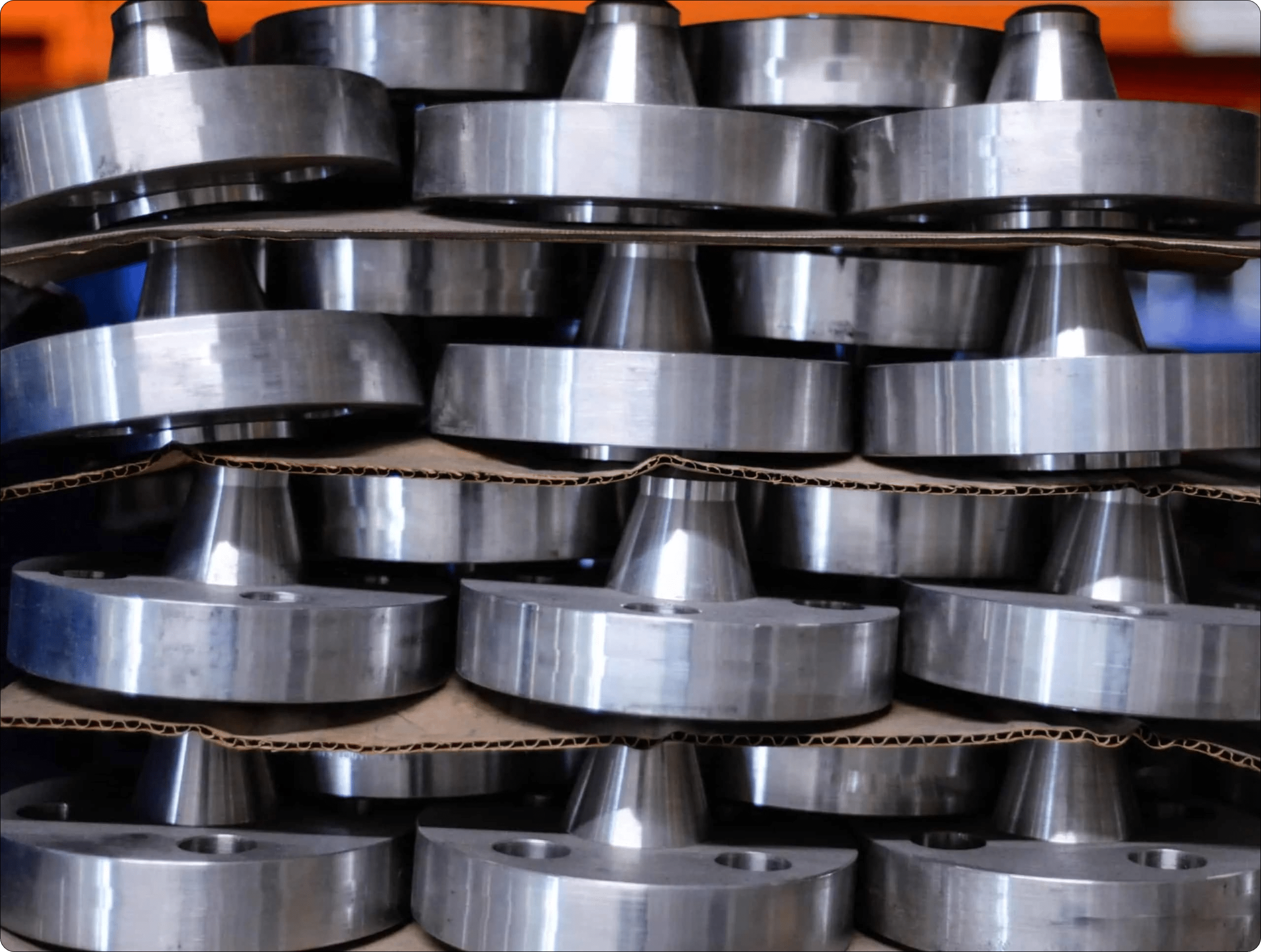
For sizes and materials where domestic mills are competitive, that’s not a bad outcome. For sizes domestic mills don’t make in volume (some large-diameter B16.47 sizes, certain exotic alloys, specialty AWWA configurations), buyers are paying the tariff or waiting longer. Stocking distributors who carried inventory through the policy shift have been able to insulate customers from spot-price moves. Distributors that buy to order are exposed to whatever the duty looks like the day the container clears customs.
BABA and AIS: Domestic Content Tightens Again
Build America Buy America (BABA) requirements have been ramping in stages. Two milestones matter for current and upcoming federal projects.
Final assembly in the U.S. As of October 1, 2025, manufactured products on federally funded infrastructure projects must be assembled in the U.S.
55 percent U.S. component cost. As of October 1, 2026, the cost of U.S.-mined, produced, or manufactured components must exceed 55 percent of the total cost of all components in the manufactured product. This is a step up from earlier thresholds and changes how some products get certified.
For flanges and fittings on federally funded water, wastewater, transportation, and infrastructure projects, the practical answer hasn’t really changed: domestic-melt, domestic-manufacture material is required, and the paperwork has to back it up. AIS (American Iron and Steel) requirements on EPA-funded water projects continue in parallel. What did change is that the documentation chain is now under closer audit, and some legacy waivers have been or are being rescinded.
If a project spec calls for AIS or BABA compliance, the questions to ask up front are: where was the steel melted, where was the flange forged and finished, and is there documentation tracing the heat number to a domestic mill. If any of those answers are vague, the order isn’t compliant.
Raw Material Volatility
Underneath the policy layer, the raw material market itself has been volatile. Forged carbon steel pricing tracks scrap and billet pricing, which tracks energy costs, trade policy, and global demand. Spot prices have moved on news cycles in ways that didn’t happen pre-2024.
The result for buyers: a quote good for thirty days is not the same instrument it was when scrap was stable. Most stocking distributors are quoting shorter validity windows, and mill-direct quotes increasingly carry escalation clauses tied to a steel index.
This affects long-lead orders more than spot-stock orders. A flange you’re buying out of distributor stock today is priced against the inventory cost when that flange landed. A flange on an eight-week mill order is priced against where the mill thinks billet will be in eight weeks, plus a buffer.
The Stocking Premium Is Real
Two things made stocking distributors more valuable in this environment. First, tariff exposure: a distributor that imported and paid duty on inventory before the April 2026 rate hike is selling out of pre-tariff stock at pre-tariff economics. Second, lead time: when mill orders carry tariff uncertainty, raw material escalation, and longer queue times, the gap between “in stock today” and “twelve to sixteen weeks from a mill order” has widened.
For projects that can wait, mill-direct still has its place on long-lead, large-quantity orders. For everything else, repair work, plant turnarounds, pipeline maintenance, anything where downtime costs more than carrying cost, buying from stock has become a more obvious move than it was in 2023.
What to Do About It
Three practical recommendations for anyone specifying or buying flanges right now.
Confirm origin and compliance up front. If the project is federally funded, get the AIS or BABA compliance status into the RFQ language. Don’t assume. The premium for domestic-melt-and-manufacture material is real but predictable; the cost of finding out a non-compliant flange shipped to a federal project is not.
Ask about the quote validity window. Thirty-day quotes still exist in some places on stock material. Mill-direct quotes are increasingly shorter or escalation-linked. Knowing which one you have changes how you handle the procurement timeline.
Build lead-time buffer into long projects. The mill queue for non-stock sizes and materials is longer than it was three years ago. If a project has a fixed start date and a non-standard flange list, place the order earlier than your 2023 instinct says.
Where Texas Flange Stands
We have seen all kinds of stock levels through the policy changes, kept depth on A105, A350 LF2, F304L, and F316L in standard ANSI classes, and maintained AWWA C207 and selected API 6A inventory. Domestic-melt-and-manufacture material is in even available for AIS and BABA projects across the sizes that move on those projects most often.
For non-standard sizes, exotic materials, and large-diameter B16.47 work, lead times depend on what the mill queue looks like the week we order. We’ll quote a real number, not a hopeful one.
If you have a project coming up and want a read on what the right buying strategy is, stock vs. mill, domestic vs. import, quote-now vs. quote-later, send us the spec list and we’ll give you an honest answer.
📞 Contact our team today for expert guidance on your next flange order.
Last updated: May 2026. Tariff rates, BABA thresholds, and material pricing change. Verify current values before committing on a long-cycle project.
Related reading: For broader context on flange types, materials, and applications across the piping family, see our complete guide to pipe flanges.