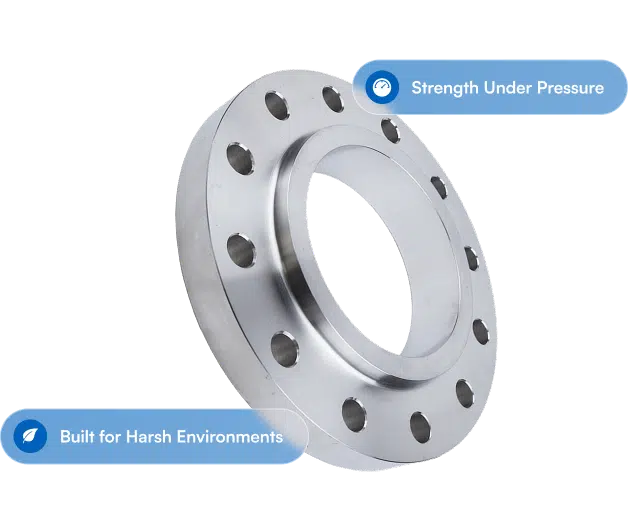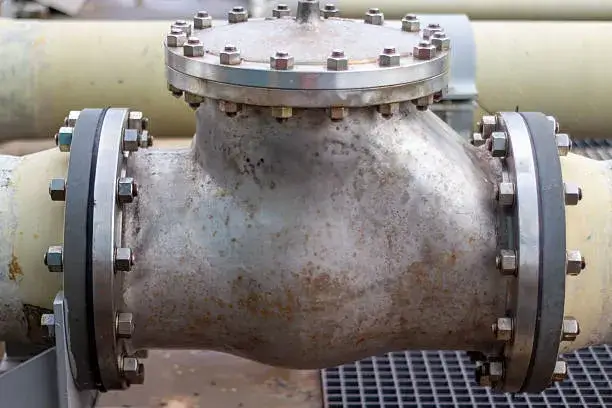
How to choose a flange comes down to six decisions. What’s flowing through the pipe, where the line lives, what the code calls for, what the budget can carry, what it has to bolt up to, and what paperwork the inspector wants to see. Get those right and the order writes itself. Get one wrong and you’re either rebuying flanges or cutting out a weld that should have never been made.
This guide walks the path in the same order our sales engineers walk it when the phone rings. We’ve been answering “how do I choose a flange” since 1986, across ANSI, ASME, API, and AWWA scope, on what is by traffic the most visited flange website on the internet. So we have a few opinions.
If you already know your spec, head to our products page and grab what you need. If you need to look up dimensions, the flange dimensions and weights reference is the place. If you’re still figuring out which flange you actually need, keep reading.
Start With What’s Flowing Through the Pipe
Before material, before pressure class, before face type, you need to define the service. The fluid, the temperature, the environment, and the code or specification governing the project drive every other decision in the chain.
Service medium. Sweet natural gas is not sour natural gas. Process steam is not utility water. Hydrocarbon liquids are not slurry. The medium tells you whether you’re in a corrosion fight, a temperature fight, an erosion fight, or none of the above. Common buckets: hydrocarbon (oil and gas), water and waterworks, steam and condensate, chemical process, food and beverage, slurry and abrasive service, cryogenic.
Operating environment. A flange installed indoors at ambient temperature has a much easier life than one buried in coastal soil, exposed to salt air, or sitting in a refinery rack getting splashed with whatever leaks above it. Sour service per NACE MR0175 has its own material rules. Cryogenic service has its own toughness requirements. High-temperature service has its own creep concerns.
Code or specification. This is the part too many buyers skip. The code driving the project is what tells you which standard the flange has to meet. A few of the heavy hitters:
- ASME B31.3 for process piping
- ASME B31.4 for liquid hydrocarbon pipelines
- ASME B31.8 for gas transmission and distribution
- AWWA C207 for steel waterworks flanges
- API 6A for wellhead and Christmas tree equipment
- ASME Section VIII Div 1 for pressure vessels
- AIS and BABA requirements on federally funded infrastructure
Once you know the code, the rest of the decision tree is pre-narrowed. ASME B31.3 in sour service rules out half the materials before you start. AWWA C207 takes you off ASME B16.5 entirely. API 6A puts you in ring-joint facings whether you wanted them or not. The application is the funnel. Everything below it is the question of which flange falls out the bottom.
Material Selection: Match the Steel to the Service
Once you know the service, you can pick the metal. Texas Flange stocks 50+ material grades because there isn’t a single right answer here. There’s a right answer for your service.
Carbon steel. ASME SA-105 forged carbon steel is the workhorse of the industry. Economical, weldable, available in stock at any size and class. Ninety percent of the standard ANSI flange market lives here. For low-temperature service down to -50°F, A350 LF2 is the move. Same machinability, better Charpy impact toughness.
Stainless grades. ASME SA-182 covers F304/304L, F316/316L, F321, and F347. F304/L handles general corrosion resistance and food and beverage cleanability. F316/L adds molybdenum for better pitting resistance in chloride environments, including coastal service and brackish water. F321 and F347 are stabilized grades for high-temperature stainless service where intergranular corrosion is a concern.
Chrome-moly grades. F11, F22, and F91 are the high-temperature alloys. Refinery service, power generation, steam systems above 750 degrees. F22 (2.25Cr-1Mo) is the most common in NACE sour service applications. F91 (9Cr-1Mo-V-Nb) is the modern choice for ultra-supercritical steam in power plants.
High-nickel alloys. Alloy 625, Alloy 825, Hastelloy C-276, Monel 400. These show up in seawater service, sulfuric acid plants, hydrofluoric acid units, and anywhere the chloride concentration eats stainless for breakfast. Lead times stretch and prices climb, but if the service demands it, nothing else works.
Duplex and super duplex. 2205 (F51) and 2507 (F53/F55). The corrosion resistance of stainless with roughly twice the strength. Common in offshore production, chloride process, and modern sour service designs that want to skip carbon steel and go straight to a long-life solution.
A small material-selection cheat sheet for the common cases:
| Service | Common Material | Why |
|---|---|---|
| General process | A105 carbon steel | Economical, weldable, in stock |
| Low-temp / cryogenic | A350 LF2 | Toughness at low temperature |
| Mild corrosion | F304/L | Good general corrosion resistance |
| Chloride exposure | F316/L | Better pitting resistance |
| Sour service | F22, F51 duplex | Meets NACE MR0175 |
| High-temp / steam | F11, F22, F91 | Creep resistance |
| Seawater | Alloy 625, F55 super duplex | Resists chloride pitting |
Two material rules that quietly cause more rebuy orders than anything else. First, mind the galvanic couple. Bolting a 304 stainless flange to a carbon-steel mating face in a wet environment sets up a corrosion cell that eats the carbon steel. Second, weld neck flanges have to match the run pipe metallurgy and the pipe schedule. F316 weld neck on A106 Grade B carbon pipe is a non-starter. Your WPS won’t approve it. Better to know before the order ships.
If material selection runs into corrosion territory, we have a corrosion prevention guide that goes deeper.
Pressure Class: The Number That Has to Match the System
Pressure class is the rating system that tells you how much pressure the flange can hold at temperature. Three numbering systems run the industry.
ANSI / ASME pressure classes. 150#, 300#, 600#, 900#, 1500#, 2500#. These are pound classes, not literal pressure ratings. A 300# flange in A105 carbon steel handles 740 psig at 100°F and 550 psig at 600°F. The pressure-temperature relationship is governed by the ASME B16.5 P-T tables for sizes 1/2″ through 24″, and ASME B16.47 for sizes 26″ through 60″. Read the tables, don’t guess.
API 6A ratings. 2,000, 3,000, 5,000, 10,000, 15,000, 20,000 psi. These are literal working pressures for wellhead service. A 6A 5K flange means 5,000 psi working pressure at the rated temperature class. Different geometry, different bore tolerances, different ring grooves. Do not cross API 6A and ASME B16.5 ratings. They aren’t the same flange in different uniforms.
AWWA classes. Class B, Class D, Class E, Class F. Lower-pressure waterworks service, ductile iron pipe interface, large bolt patterns. Class B per AWWA C207 is rated for 86 psi cold working pressure in sizes 4″ through 24″, and 75 psi in sizes 26″ through 144″. AWWA flanges have flat faces, full-faced gaskets, and a different bolt circle than ASME B16.5 of the same nominal size. They are not interchangeable.
The pressure-temperature relationship. A flange’s rated pressure drops as temperature rises. A 600# A105 weld neck rated for 1480 psig at 100°F is rated for 825 psig at 800°F (the upper limit for A105 in B16.5). Spec the flange to the highest pressure-temperature combination the system will see, including upset conditions and hydrotest. Hydrotest is the silent killer of pressure-class decisions. A system designed for 1,000 psi but hydrotested at 1,500 psi needs flanges rated for 1,500 psi at the test temperature, not the design temperature.
For dimensional and pressure-temperature lookups, use the flange dimensions and weights reference. The tables are right there.
Face Type: How the Flange Seals to the Gasket
Face type is the geometry of the sealing surface. Pick wrong and the gasket leaks no matter how perfectly you torqued the bolts.
Raised Face (RF). The default for ASME B16.5 service. The face stands proud of the bolt circle by 1/16 inch (Class 150 and 300) or 1/4 inch (Class 400 and above per B16.5). Concentrates bolt load on the gasket, seats reliably, works with a wide variety of gasket materials. I’d say 70 percent of every flange shipped is raised face.
Flat Face (FF). Full-face gasket, no raised area. Used when bolting to cast-iron pumps, valves, or vessels that would crack under the eccentric load of a raised-face flange. The rule of thumb: if the mating component is brittle (cast iron, fiberglass, low-strength bronze), go flat face with a full-face gasket. If you raised-face a cast-iron pump volute, you’re going to crack the volute. We’ve seen it.
Ring Type Joint (RTJ). Metal-to-metal seal using a soft iron, soft steel, or alloy ring (oval or octagonal cross section) seated in a machined groove on the flange face. Used in high-pressure / high-temperature service per ASME B16.5 600# and above, and is the only acceptable face type for API 6A service. Specified per ASME B16.20 for the gasket.
Tongue and Groove (TG), Male and Female (MF). Special service. The tongue or male side seats into the matching groove or female side, locating the gasket and preventing extrusion. Used in lethal service, hydrogen, and certain process applications where the gasket cannot be allowed to blow out under upset conditions.
The most common face-selection mistake is wishing a flange were something it isn’t. The flange has to match what it bolts to. If the existing system is raised face and the new component is flat face, you don’t get to “just make it work.”
For the deeper raised-face technical breakdown, the raised-face flange guide covers the gasket math and sealing mechanics.
Size and Bore: Where Drawings Beat Guesses
This is where field surprises live. The size of a flange isn’t its outside diameter. It’s the nominal pipe size (NPS) of the pipe it bolts to. A 6-inch NPS pipe has a 6.625-inch outside diameter. That’s the pipe OD, not the flange OD. The flange OD is bigger because it has to carry bolts.
Nominal pipe size. Per ASME B36.10M (carbon steel pipe) and ASME B36.19M (stainless steel pipe), pipe sizes are nominal up to 12 inches and equal to the actual OD from 14 inches up. The bore of a weld-neck flange has to match the pipe schedule. Schedule 40, Schedule 80, Schedule XXS, and so on, all have different inside diameters. Order a 6-inch Schedule 40 weld neck thinking it’ll fit your 6-inch Schedule 80 pipe and you’re going to have a bore-mismatch problem at the welder.
Bore matching. Weld-neck flanges and socket-weld flanges have a specific bore that matches a specific pipe schedule. Slip-on flanges, blinds, threaded flanges, and lap joints don’t care about pipe schedule because they don’t have a butt-weld bore. If you’re ordering weld-necks, the schedule matters and has to be on the order. “6-inch 300# RF weld neck” is incomplete. “6-inch 300# RF weld neck Sch 40 A105” is complete.
Custom bores. If the project drawing calls for a non-standard bore, we can usually get it cut. Standard ANSI sizes ship from stock. Custom bores typically run two to three weeks depending on grade and size.
The dimensional reference for nominal sizes, bore diameters, bolt circles, and overall lengths lives at the flange dimensions and weights page.
Standards Compliance and Mill Documentation
This is the paperwork section. It feels boring until the inspector asks for it and you don’t have it.
ASME vs. ANSI naming. Most of the flange standards used to be ANSI standards. Over the last twenty-five years, ANSI has handed maintenance of those standards over to ASME. The result: B16.5 used to be ANSI B16.5, then ANSI/ASME B16.5, and is now ASME B16.5. They’re the same standard. The current revision is ASME B16.5-2020. ASME B16.47 (large diameter) is also at the 2020 revision. ASME B16.20 (RTJ and spiral wound gaskets) is at the 2017 revision. If a spec calls out “ANSI B16.5,” it means current ASME B16.5. Don’t get hung up on it.
Buy American / AIS / BABA. Federally funded infrastructure projects (water utilities, transit, certain bridges and roads) require Build America Buy America (BABA) and AIS-compliant fittings. That means the flange has to be melted and manufactured in the United States, with documentation to prove it. Texas Flange stocks domestic-melt domestic-manufacture flanges across ANSI and AWWA scope. Ask before you buy. The premium isn’t huge, but the paperwork is non-negotiable.
Material Test Reports (MTR). An MTR is the certificate from the mill showing the chemical composition and mechanical properties of the heat the flange was forged from. ASME SA-105, SA-350, and SA-182 all require MTRs. Every flange Texas Flange ships can come with an MTR on request. Ask for it on the PO if your spec requires it. Don’t ask for it after the flange is welded into the line.
Certificate of Conformance (CofC). A statement from the supplier that the product meets the specified standard. Less data than an MTR, often paired with it for AWWA and commodity-grade orders.
Mill marking. Every legitimate forged steel flange has a mill stamp showing heat number, size, class, material grade, and manufacturer. ASME B16.5 specifies the marking convention (size and rating on the OD, material and heat on the hub). If a flange shows up unmarked, that is a red flag. ASTM A961 is the general requirements specification covering this for steel flanges.
For the full MTR breakdown, including how to actually read one and what to look for, see the mill test report guide.
Quick Decision Flow
Six steps, in order. Walk them through every time and the spec gets right.
- Define the service. Medium, temperature, pressure, environment, governing code.
- Pick the material. Driven by the service. Carbon, stainless, chrome-moly, nickel alloy, duplex.
- Pick the pressure class. Driven by the P-T tables, including hydrotest and upset conditions.
- Pick the face type. Has to match what it bolts to. RF, FF, RTJ, TG, MF.
- Pick the size and bore. NPS, schedule for weld-necks, custom bore if the drawing calls for it.
- Confirm standards and documentation. ASME / API / AWWA, AIS if federal, MTR if specified, CofC if required.
Step seven is unofficial and free: call us with what you have and we’ll fill in the blanks. Sales engineers who have spec’ed this exact line a hundred times will save you a week of digging through standards on a spec you’ve never written before.

FAQs
What is the difference between ANSI and ASME flange standards?
Same standards, different administrators. ANSI handed administration of the flange standards (B16.5, B16.47, B16.20, and so on) to ASME over the last twenty-five years. A current ASME B16.5 flange is what people still casually call an “ANSI flange.” The dimensions are the same.
How do you match a flange to a pipe schedule?
For weld-neck and socket-weld flanges, the bore is cut to match a specific pipe schedule. Order a 6-inch 300# RF weld neck Schedule 40 to mate to 6-inch Schedule 40 pipe. For slip-on, blind, threaded, and lap-joint flanges, the schedule isn’t part of the order because the flange doesn’t have a butt-weld bore.
What’s the highest pressure class flange you can get?
Per ASME B16.5, the top class is 2500#. For higher pressures, you move to API 6A wellhead flanges, rated up to 20,000 psi. Beyond that you’re in custom territory and a sales engineer should be on the call.
Are RF and FF flanges interchangeable?
No. Bolting a raised-face flange to a flat-face cast-iron mating component will crack the cast iron under bolt-up. Match the face type to the mating component, or use a transition spool. Raised face on raised face is fine. Flat face on flat face is fine. Mixed is a leak waiting to happen.
What’s the right material for sour service?
Per NACE MR0175 / ISO 15156, sour service materials are limited to grades that resist sulfide stress cracking. F22 chrome-moly, F51/F55 duplex, A350 LF2 within hardness limits, and several nickel alloys all qualify. The exact grade depends on the partial pressure of H2S, the temperature, and the chloride content. Don’t pick a sour-service grade off a chart. Pick it off the project’s NACE-compliant material spec.
Do I need an MTR?
If the spec calls for one, yes. ASME B31.3 process piping, API 6A wellhead, and most government-funded infrastructure require MTRs. Texas Flange supplies MTRs on request at no extra charge for stock material.
What’s the lead time on a custom-bored flange?
Standard ANSI sizes ship from stock the same or next business day. Custom bores typically run two to three weeks depending on grade and size. Special materials (high-nickel alloys, duplex) can run longer. Get the spec to us early and we’ll tell you the real lead time before you commit.
What’s the difference between a flange and a fitting?
A flange is a forged or cast disc designed to bolt to a mating flange. A fitting (elbow, tee, reducer, cap) is a forged or fabricated piece used to change direction, branch, or close out a pipeline. Both are pipe components, both ship from Texas Flange, both meet ASME standards. They just do different jobs.
Get the Right Flange the First Time
How to choose a flange comes down to six decisions: application, material, pressure class, face type, size and bore, standards and documentation. Walk them in order and the spec writes itself. Skip one and you’re rebuying.
Texas Flange has been answering these questions since 1986. Stock depth across ANSI, ASME, API, and AWWA standards, in 50+ material grades, with MTRs available on every order and AIS-compliant material in stock for federal projects. Direct line to a sales engineer who has seen the spec before.
Send us your specs and we’ll quote it. If the spec is messy, we’ll help you clean it up before the PO ever leaves your desk.
Send us your specs | Browse stock | Look up dimensions
📞 Contact our team today for expert guidance on your next flange order.
Last updated: May 7, 2026.
Related reading: For background on flange types, components, and how they fit into a piping system, see our complete guide to pipe flanges.