MSS SP-44 Flanges: What They Are, When You’ll See Them, and How They Differ from ASME B16.47
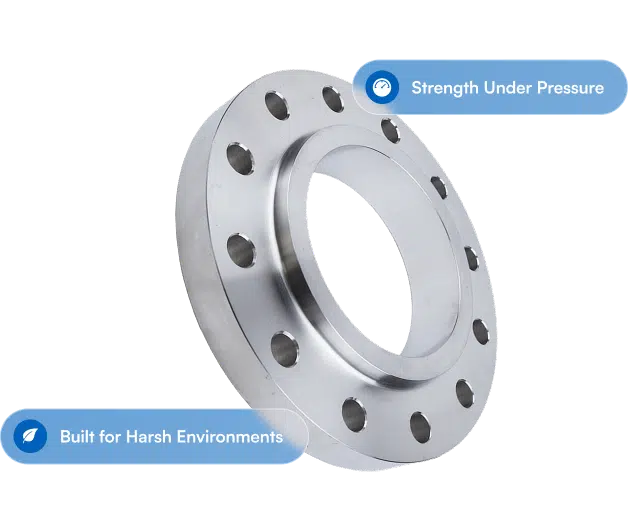
If you’re on a transmission pipeline project (natural gas, crude, refined products, or NGLs), the flanges on your spec might not be certified ONLY to ASME B16.5 and B16.47; they probably comply with MSS SP-44 as well. This is the Manufacturers Standardization Society standard that covers high-yield carbon steel flanges for cross-country transmission pipelines. SP-44 feeds directly into ASME B16.47 Series A on the dimensional side (same bolt circles, same bolt counts, same outside diameters), but the material specification (ASTM A694) and the service conditions (ASME B31.4 and B31.8) are somewhat their own. This post walks through what MSS SP-44 actually is, which ASTM A694 grades show up on a real transmission bid, and where pipeline contractors most often get the spec wrong.
What MSS Is and What SP-44 Covers
The Manufacturers Standardization Society of the Valve and Fittings Industry (MSS) publishes practice standards (the SP series) that fill gaps not directly addressed by ASME or ANSI. MSS SP-44, currently in the 2019 edition, specifically covers steel pipeline flanges through NPS 60, and pressure classes 150# through 900#. The standard is focused on one narrow but important use case: flanges welded onto cross-country transmission pipelines where the carbon steel yield strength drives the pipe wall thickness calculation. That is a fundamentally different design basis than ASME B16.5 (which serves process piping on allowable stress) or ASME B16.47 (which covers large-diameter industrial flanges), and it’s why SP-44 exists as its own specification.
ASTM A694: The High-Yield Grade System
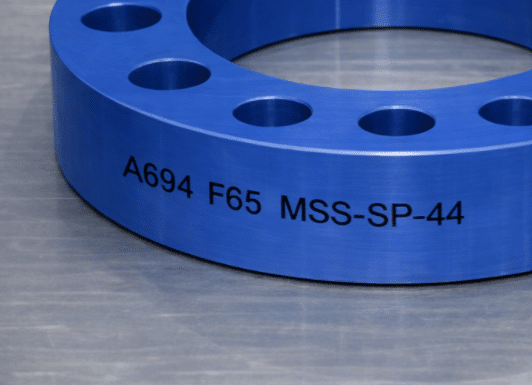
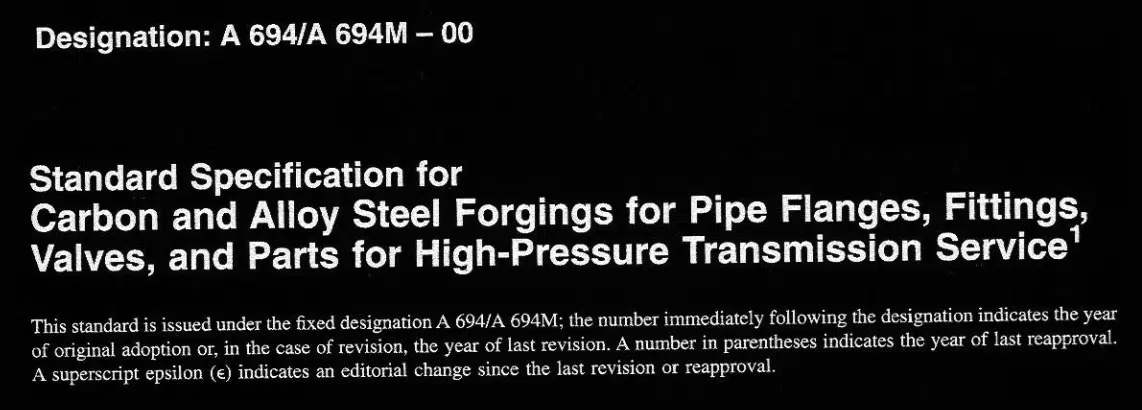
SP-44 references ASTM A694 / A694M for material. A694 covers carbon and alloy steel forgings specifically designed for high-yield pipeline service. The grade designation is the specified minimum yield strength (SMYS) in ksi. On modern pipeline bids you will see F42, F52, F60, F65, and F70 most frequently. F42 shows up on lower-pressure gas gathering and distribution, and quite a bit of mass produced ASTM A105 carbon steel often qualifies for F42 if you check yield and tensile strength paperwork. The higher yielding F52, F60, and F65 are the workhorses of natural gas transmission. F70 rides on long-haul crude and NGL pipelines where pressure and wall thickness are optimized for high-pressure transport. The point of the grade system is SMYS matching: an A694 F60 flange is built to weld onto API 5L X60 line pipe, F65 matches X65, F70 matches X70, and so on. Welding a lower-yield flange onto higher-yield pipe requires an engineered transition, and not just a shrug and a guess.
Dimensional Overlap with ASME B16.47 Series A
MSS SP-44 dimensions and ASME B16.47 Series A dimensions are identical over the size range where they overlap (NPS 26 through NPS 60, Class 150 through 900). That’s not a coincidence. ASME adopted SP-44 as the dimensional basis for Series A when it created B16.47. What SP-44 adds, and what B16.47 does not explicitly cover, is the smaller transmission pipeline sizes (NPS 12 through 22) and the explicit A694 high-yield grade callouts. So a 30 inch Class 600 MSS SP-44 F60 flange and a 30 inch Class 600 ASME B16.47 Series A flange have the same bolt circle, same bolt count, same OD, and same raised face dimensions. The difference is the standard on the certification and the yield class on the MTR, not the geometry.
Where SP-44 Fits: ASME B31.4 and B31.8 Service
SP-44 flanges are designed to live in one kind of system: pipelines operated under ASME B31.4 (liquid hydrocarbon transportation) or ASME B31.8 (gas transmission and distribution). These codes use SMYS-based design with a specified design factor (0.72 typical for B31.8 Class 1 locations, lower for higher-density areas), which is fundamentally different from ASME B31.3 process piping design on allowable stress tables. A flange welded into a B31.8 line has to match the pipe’s yield class so that the finished joint meets the pipeline design factor. That design logic is the reason A694 has so many SMYS steps in the first place. F52 and F60 are the most common mainline specs for natural gas transmission today. F65 and F70 show up on newer high-pressure corridors and long-haul liquid lines.
Service Considerations: Hydrogen, Sour, and Cold
MSS SP-44 material is carbon steel, so the standard carbon steel service rules apply on top of it. Hydrogen service (per ASME B31.12, or dedicated H2 pipelines) adds specific requirements for hardness, carbon equivalent, and sometimes a supplemental PSL level on the forging. Sour service brings NACE MR0175 / ISO 15156 into play and narrows the acceptable hardness range (187 HBW for A694 mirroring the A105 rule). Cold-service B31.4 pipelines in Alaska, Western Canada, or high-altitude corridors typically require supplemental Charpy impact testing per A694 Supplementary Requirement S5, tested at the minimum design temperature. None of these overlays are covered inside SP-44 itself. You layer them on top of the base spec.
Common Procurement Mistakes
Four things come up repeatedly on real SP-44 orders. First, buyers specify “A694 F60” without the class or the facing type, and the shop has to call back twice to close the spec. F60 is a material grade. It is not a pressure class. Second, pipeline contractors sometimes assume MSS SP-44 is interchangeable with ASME B16.47 Series A, which is true dimensionally but not on certification: a B16.47 Series A flange with A105 material is not an SP-44 flange, because SP-44 mandates A694. Third, bolting gets overlooked. An SP-44 joint uses the same ASTM A193 B7 studs and A194 2H heavy hex nuts as any B16.47 joint, unless the pipeline is in sour service, in which case B7M and 2HM are mandatory (see our separate post on NACE MR0175 for the full bolting implications). Fourth, MTRs on A694 need to include full chemistry and Charpy data where S5 is invoked. A boilerplate A105-style MTR is not sufficient for a transmission pipeline joint.

Closing the Loop
MSS SP-44 is specialized, and the spec details matter more than they do on general industrial flange orders. If you have a transmission pipeline bid package and want to confirm the right A694 grade, facing, and bolting combination before the order goes out (or if you’re seeing F60 and F65 on a bid and not sure which one actually matches the line pipe), contact Texas Flange. For related reading, our piece on how steel tariffs affect flange pricing is particularly relevant for midstream buyers sourcing SP-44 volumes in today’s market.
Texas Flange & Fitting Supply | 281-484-8325 | [texasflange.com](http://texasflange.com)