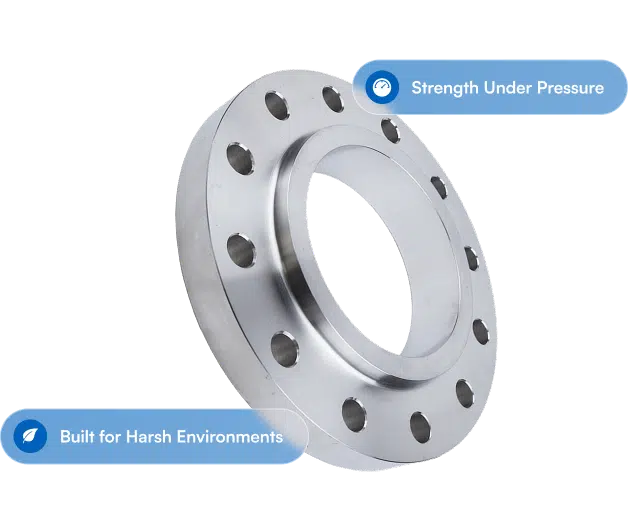
Choosing the right material for industrial flanges is critical to ensuring durability, performance, and safety in piping systems. Whether you’re working in oil & gas, petrochemical, or cryogenic applications, material choice can significantly impact system reliability. Both ASTM A105 and A350 LF2 Flanges are widely used carbon steel flanges in multiple industrial applications. Understanding their properties, uses, and specifications will help you make an informed decision based on your project’s needs.
What Is an ASTM A105 Flange?
ASTM A105 flange refers to flange used mainly in high-temperature environments and made from forged carbon steel. It’s a standard material in ASME B16.5 flanges and fittings, prized for its strength and availability.
- Chemical Composition: Carbon Steel A105 flanges contain carbon, manganese, phosphorus, sulfur, and silicon. This combination ensures good weldability and toughness under pressure.
- Mechanical Properties: This carbon steel features high tensile strength (70-95 ksi) and yield strength (~36 ksi), making it reliable in structural and high-stress environments.
- Applications: ASTM A105 flanges are commonly found in piping systems, oil and gas infrastructure, steam pipelines, and general industrial services.
- Temperature Range: These carbon steel flanges are designed for normal to high-temperature applications, supporting conditions up to around 800°F (425°C), but not ideal for cold or cryogenic environments.

What Is a ASTM A350 LF2 Flange?
The ASTM A350 LF2 flange specification applies to low-temperature carbon steel, specifically developed to withstand colder environments where impact resistance is critical.
- General Description: ASTM A350 is a material specification for carbon and low-alloy steel forgings produced with added toughness and impact testing for extreme cold.
- Chemical Composition: ASTM A350 is similar o ASTM A105, but with controlled carbon and manganese levels for improved performance in low temperatures.
- Mechanical Properties: ASTM A350 features yield strength (~36 ksi), tensile strength (~70-95 ksi), and meets Charpy V-Notch impact tests at -50°F (-45°C).
- Applications: These flanges are ideal for cryogenic piping, LNG plants, offshore oil rigs, and environments requiring strict temperature and pressure specifications.
- Certifications: Typically compliant with ASTM, ASME, and NACE MR0175 standards makes these flanges suitable for critical applications requiring low temperature flange material performance.
ASTM A105 vs A350 LF2
Chemical Composition
| Element | A105 | A350 LF2 |
| Carbon | Up to 0.35% | Up to 0.30% |
| Manganese | 0.60% – 1.05% | 0.60% – 1.35% |
| Silicon | 0.10% – 0.35% | 0.15% – 0.30% |
| Phosphorus | Max 0.035% | Max 0.035% |
| Sulfur | Max 0.035% | Max 0.040% |
Mechanical Properties
| Property | A105 | A350 LF2 |
| Yield Strength | ≥ 250 MPa | ≥ 250 MPa |
| Tensile Strength | ≥ 485 MPa | ≥ 485 MPa |
| Elongation | ≥ 22% | ≥ 22% |
| Impact Testing | Not Required | Required at -50°F |
When analyzing ASTM A105 vs A350 LF2 Flanges, it’s essential to review key differences:
Temperature Resistance
- A105: Effective for elevated temperatures only.
- A350 LF2: Approved for cryogenic service down to -50°F.
Applications and Industry Use
- A105: Used in standard industrial piping, oil refineries, and steam lines.
- A350 LF2: Chosen for cryogenic systems, LNG transport, and offshore installations where failure is not an option.
Cost and Availability
A105 flanges are more economical and widely available. A350 LF2, due to testing and cold-weather certification, tends to be more expensive but necessary for specific systems.
Comparison Table
| Feature | A105 | A350 LF2 |
| Temperature Range | Up to 800°F (425°C) | Down to -50°F (-45°C) |
| Applications | General industry, oil & gas | Cryogenic, offshore, LNG |
| Impact Testing | Not required | Required (Charpy V-Notch) |
| Certification | ASTM A105 | ASTM A350 LF2, NACE MR0175 |
| Cost | More affordable | Slightly higher |
| Availability | Very high | Moderate to high |
When to Choose A350 LF2 Over A105
Opt for ASTM A350 LF2 flanges when your system must endure:
- Cold or cryogenic environments: A350 LF2 provides guaranteed performance at extremely low temperatures.
- Impact test compliance: Projects that require certified impact resistance must use ASTM A350 LF2.
- Variable pressure and thermal cycles: Systems exposed to repeated stress changes benefit from A350 LF2’s toughness.
- Strict code requirements: When international standards (like NACE MR0175 or ASME B16.5) must be met.
Understanding when ASTM A105 vs A350 LF2 Flanges are appropriate can prevent costly downtime and ensure long-term system integrity.
Conclusion
The comparison of ASTM A105 vs A350 LF2 Flanges comes down to application, temperature range, budget, and compliance. If you’re working in high-temperature, non-critical environments, A105 offers excellent value and availability. However, for cold climate or pressure-variable systems, A350 LF2 flange specification offers superior reliability, thanks to its impact testing and low temperature flange material formulation.
Both materials fall under the umbrella of carbon steel flanges, and understanding their differences can lead to better system performance, safer operations, and longer equipment life. Choosing the right forged flange materials ultimately depends on your specific use case and engineering requirements.
Still unsure about ASTM A105 vs A350 LF2 Flanges? Our experts at Texas Flange are ready to assist you. Whether you’re navigating piping system requirements, choosing materials for a cryogenic plant, or looking for custom flange solutions, we can help.
📞 Get in touch with our team or request a quote today through our official site:
🔗 Texas Flange Home
Let’s find the right flange material for your application with confidence and precision.