Selecting the correct flange standard is a small decision that will shape installation, maintenance and compliance for the life of a pipeline. The comparison awwa vs ansi flange matters because these standards reflect different design assumptions, intended uses, and pressure classes. This guide explains what an AWWA flange is, how it differs from ANSI (ASME) flanges, and practical steps to choose the right option for waterworks, industrial piping, or mixed-spec projects. You’ll also find clear, step-by-step instructions to access CAD models and PDF drawings so you can integrate the flange data into your engineering workflow.
What Is an AWWA Flange?
Definition (AWWA standards)
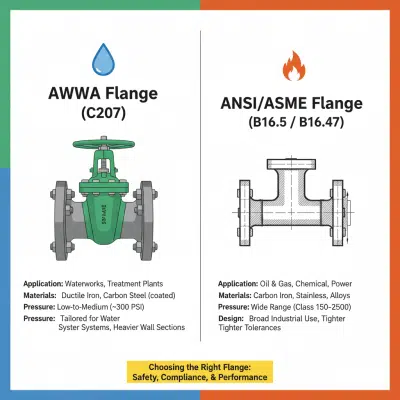
An AWWA flange follows the American Water Works Association standards (notably AWWA C207 for blind and hub flanges and other related AWWA specs). These standards are tailored for water distribution and treatment systems, focusing on compatibility with valves, pipeline fittings, and municipal infrastructure.
Typical uses
- Water distribution mains and service connections
- Treatment plants, pumping stations, and potable water systems
- Low- to medium-pressure pipelines where corrosion-resistance and ductile iron options are common
Materials commonly used
AWWA flanges frequently use ductile iron, cast iron, and carbon steel; protective coatings and linings are common to meet potable-water requirements. Stainless steel is used selectively for corrosive environments.
Pressure ratings
AWWA flange ratings are commonly in the lower-to-mid pressure range (often up to ~300 psi for many municipal applications), and their designs optimize sealing, corrosion protection, and integration with waterworks fittings.
(See AWWA flange resources at Texas Flange for drawings and specs.)
https://www.texasflange.com/awwa-flanges/
What Is an ANSI Flange?
Definition (ANSI / ASME B16.5 / B16.47 standards)
When we say “ANSI flange” in practice we usually mean flange designs set by ASME/ANSI standards such as ASME B16.5 (NPS up to 24″) and ASME B16.47 (large diameter flanges). These standards are widely used across general industry and cover a broad range of pressure classes and materials.
Typical uses
- Oil & gas pipelines, refineries, and chemical plants
- Power generation and high-temperature steam systems
- High-pressure process piping in industrial facilities
Materials commonly used
ANSI (ASME) flanges are commonly produced in carbon steel, low-alloy steel, stainless steels (304/316), and a wide selection of specialty alloys for high-temperature or corrosive services.
Pressure ratings
ANSI/ASME classes range from Class 150 up to Class 2500, covering low through very high pressures. That broad scope makes ANSI flanges the default in many heavy-duty industrial applications.
(See ANSI flange resources at Texas Flange for drawings and specs.)
https://www.texasflange.com/ansi-flanges/
AWWA vs ANSI Flange: Main Differences
Below are the practical distinctions to consider when comparing awwa vs ansi flange options.
Design Standards (AWWA C207 vs ASME B16.5)
- AWWA: focuses on pipe and valve interfaces common to municipal water—dimensions and jointing assume ductile iron and waterworks fittings.
- ANSI/ASME: defines broader mechanical dimensions, bolt patterns and pressure class definitions for industrial piping. ASME standards provide tighter tolerances for high-pressure and high-temperature service.
Pressure Ratings (low vs high pressure)
- AWWA: optimized for low-to-medium pressures typical of water distribution (commonly up to ~300 psi).
- ANSI: covers a wide pressure range (Class 150 → 2500), appropriate for aggressive industrial services.
Applications (waterworks vs industrial)
- Use AWWA for water treatment, mains and municipal projects.
- Use ANSI/ASME for refineries, chemical plants, power stations, and high-pressure pipeline systems.
Dimensions and Thickness
- AWWA flange thickness and bolt patterns are set for compatibility with waterworks fittings and are often heavier in certain diameters to meet municipal handling and installation practices.
- ANSI flanges follow ASME dimensional tables; thickness, raised-face heights and bolt circle diameters vary by class and are standardized for cross-industry compatibility.
Cost and Availability
- AWWA parts (esp. ductile iron) may be more economical for municipal projects but availability depends on regional suppliers.
- ANSI flanges (carbon/stainless) are widely available worldwide in many pressure classes; specialty alloys increase cost.