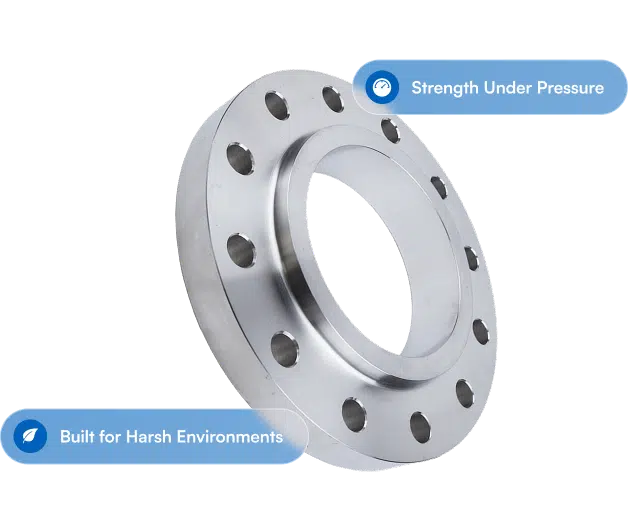
In the world of industrial piping and pressure systems, choosing the right type of flange for branch connections is critical for ensuring safety, efficiency, and longevity of your installation. Two commonly used components in these applications are the flangeolet and nipoflange.
Both serve as branch-type fittings that allow for the addition of a flange to an existing pipe system, but their design, installation methods, and ideal use cases differ significantly.
What is a flangeolet?
A flangeolet is a specialized branch fitting used to create a flanged connection on a pipe where no flange previously existed. It combines a short pipe segment with a flange, allowing easy connection to piping systems, valves, or equipment.
- Branch-type connection with flange: The flangeolet is designed as a branch outlet welded directly to the main pipe, providing a strong, reinforced connection point.
- Installed with welding and bolts: The fitting is typically welded onto the main pipe by butt welding or socket welding, and the flange end allows bolted connections to other equipment.
- Used for pipe branches and reinforcements: Flangeolets are widely used in systems where branch lines need to be added without compromising the main pipe’s structural integrity. They help reinforce the branch area, distributing stress effectively.
Flangeolets are often used in industries like oil and gas, petrochemical, and power generation, where safe, robust branch connections are vital.
What is a nipoflange?
A nipoflange (sometimes spelled “nipo flange”) is a unique combination fitting that integrates a pipe nipple with a flange.
- Combination of nipple and flange: Unlike the flangeolet, a nipoflange consists of a short, threaded or welded nipple with a flange attached to one end.
- Suitable for high-pressure lines: The nipoflange’s design is ideal for high-pressure and high-temperature pipelines, where minimal space and maximum integrity are essential.
- Installed by butt welding: Nipoflanges are typically installed by butt welding the nipple end to the pipe, then bolting the flange end to equipment or another flange.
Nipoflanges are often preferred in compact piping layouts and in systems subject to vibration, thermal expansion, or other stresses requiring a highly reliable joint.
Key differences between flangeolet and nipoflange
| Feature | Flangeolet | Nipoflange |
| Design | Branch fitting with integral flange | Nipple with integral flange |
| Connection type | Welded branch connection | Butt-welded nipple with bolted flange |
| Space requirements | Requires more space due to branch design | Compact design, fits in tighter spaces |
| Ideal applications | Branch connections, pipe reinforcements | High-pressure lines, vibration-prone systems |
| Main advantage | Distributes stress on pipe branch | Compact and robust connection with minimal stress |
The difference in design and application is important when selecting the appropriate option for a specific use.
When making your choice, you should consider several important factors, such: as the required pressure ratings that the system must safely withstand;, the amount of available space where the component will be installed;, and the various mechanical stresses that may be encountered during operation.
Additionally, considerations like durability, maintenance needs, and compatibility with other system parts also impact the decision-making process. Managing these elements ensures optimal performance, safety, and longevity in the chosen design and application.
Flangolet vs Nipoflange
Which performs better?
Pressure and temperature resistance
When comparing flangeolet vs nipoflange, the nipoflange tends to offer superior pressure and temperature resistance. This is because the nipple portion provides a straight-through flow path with fewer stress concentration points. The weld joint of a nipoflange is typically butt welded, offering a robust seal suitable for high-pressure service.
Flangeolets, while strong and reinforced, may not handle extreme pressures as effectively as nipoflanges because of their branch design, which introduces stress points at the branch junction.
Maintenance and long-term reliability
From a maintenance standpoint, flangeolets allow easier access for disassembly due to their flange connection on the branch. This can be advantageous in systems requiring frequent inspection or replacement of branch components.
Nipoflanges offer excellent long-term reliability in demanding conditions with minimal leakage risk but may be less accessible in tight spaces where disassembly is challenging.
When to use a flangeolet
Flangeolets are the preferred choice when:
- A pipe branch is needed: If your system requires adding a branch line for instrumentation, flow measurement, or secondary piping, flangeolets provide a reinforced, reliable solution.
- Disassembly may be required: Systems that demand periodic maintenance or inspection benefit from flangeolets because of their accessible flange connections.
- Reinforcement of the pipe wall is critical: The branch design helps distribute stresses, reducing fatigue and crack formation around the branch area.
Flangeolets are typically ordered along with weldo flanges, which are common flange types designed to be welded to pipes or fittings.
When to choose a nipoflange
Nipoflanges should be considered:
- For compact, high-integrity connections: When there are space constraints and a streamlined connection is necessary, nipoflanges provide a smaller footprint than flangeolets.
- Systems with high pressure or vibration: The butt-welded joint and nipple design offer strong resistance to vibration and cyclic loading.
- Where minimal flow disruption is critical: The straight flow path through the nipple helps reduce turbulence and pressure drop.
Nipoflanges are often the best option in oil refineries, chemical plants, and power stations because of their suitability in demanding environments.
Choosing the right fitting
Understanding the nuances between flangeolet and nipoflange is essential for designing safe and efficient piping systems. Your decision depends on your system’s pressure, temperature, space constraints, and maintenance needs.
- Choose flangeolets when you need a robust branch connection with easier access for maintenance and reinforcement at the branch point.
- Opt for nipoflanges when working in high-pressure or vibration-prone environments requiring compact, high-integrity joints.
Both fittings can be engineered from various materials compatible with your application, including carbon steel, stainless steel, and alloys. For detailed design and planning, engineers often refer to our CAD / 3D flange drawings to visualize and verify flange integration into yourthe pipeline.
For expert advice and sourcing quality components like flangeolets, nipoflanges, other weldo flanges, and other piping connectors, contact Texas Flange, your trusted supplier of industrial flange solutions</>
If you want precise recommendations for your next project or help interpreting technical specs like pressure ratings and material compatibility, the experts at Texas Flange are ready to assist you.