Introduction
In industrial piping systems, failure doesn’t always announce itself with fanfare. It begins at the weakest link in your assembly, often at a weld neck flange connection that seemed secure until pressure, temperature, or time revealed otherwise. While procurement teams focus considerable attention on selecting the right pipe flange for their application, the reality is more nuanced: a reliable connection isn’t just about the flange itself. You have to consider the complete assembly, matching the correct flange type with compatible fasteners and appropriate sealing materials.
This post examines the critical components of a secure flange assembly, from understanding when to specify a weld neck versus a companion flange, to selecting hardware and gaskets that won’t compromise your system’s integrity. Whether you’re specifying components for new construction or sourcing replacements for existing infrastructure, understanding these relationships can prevent costly failures and unplanned downtime.
The Core Foundation: Selecting the Right Pipe Flange Type
The first decision in any flange assembly is choosing the appropriate flange configuration for your specific application. While dozens of flange types exist across various standards, two configurations dominate higher pressure industrial piping systems: the weld neck flange and the companion flange. Understanding when each is appropriate forms the foundation of a reliable connection.
The Weld Neck Flange: Built for Stress
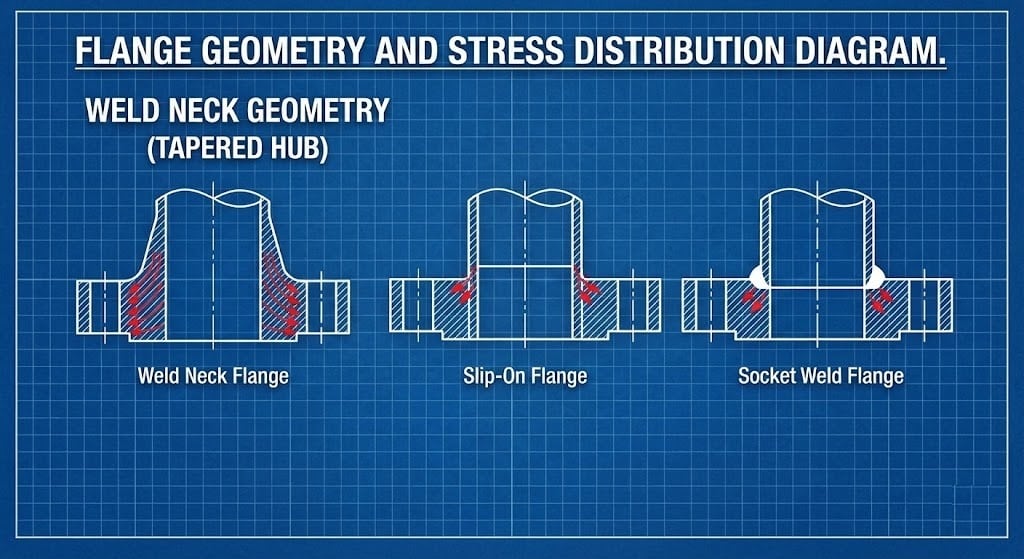
The weld neck flange represents the gold standard for high-pressure and critical service applications. Its distinctive feature is a long, tapered hub that transitions gradually from the pipe wall thickness to the flange end. This geometry isn’t merely aesthetic; it serves a crucial structural purpose by distributing stress concentration away from the base of the flange and into the entire body of the flange above it.
When you butt-weld a weld neck flange to your piping, you’re creating a reinforced connection that can withstand significant bending moments, fatigue cycling, and pressure spikes. The tapered hub acts as a stress intensification buffer, making this design ideal for applications involving:
- High-pressure steam systems
- Critical process lines where failure would result in safety incidents
- Thermal cycling environments where expansion and contraction create repeated stress
- High-temperature services above 400°F
The trade-off for this superior performance is cost and installation complexity. Weld neck flanges are often more expensive than slip on styles of similar pressure class, and require skilled welders and often mandated radiographic inspection. For applications where reliability isn’t negotiable, this investment pays dividends in operational uptime.
The Companion Flange: Versatility in Connection
The term companion flange often creates confusion because it describes function rather than a specific structural design. A companion flange is simply any flange used to mate with equipment nozzles, valve bodies, pump casings, or other flanged connections. These flanges can be slip-on, threaded, or even weld neck designs, depending on the application requirements. As a general rule, the term companion flange in the PVF world typically means the connection is a threaded style (NPT, BSPT, etc)
Where companion flanges truly distinguish themselves is in their versatility for equipment connections. When connecting piping to a centrifugal pump with a flanged discharge, you’re effectively using a companion flange. When bolting up to a control valve, that can be considered a companion flange application. The key consideration is matching the pressure class, facing type, and bolt circle diameter to the equipment being connected.
Threaded companion flanges offer particular value in smaller diameter applications (typically 2 inches and below) where welding costs become disproportionate to the pipe size. They allow for field assembly without hot work permits and can be disassembled for maintenance more readily than welded connections. However, they’re generally limited to somewhat lower pressure services and applications without significant vibration, and weld neck styles will always be considered superior.
The Hardware That Holds It Together: Flange Bolts and Nuts
Once you’ve selected the appropriate flange configuration, hardware selection becomes critical, yet it’s often treated as an afterthought in the procurement process. This oversight can be costly. A flange assembly is only as strong as the weakest component, and mismatched or under-specified hardware represents a common failure point in industrial piping systems.
The fundamental principle in hardware selection is material compatibility and grade matching. Your flange bolt and corresponding flange nut must meet or exceed the mechanical properties required for the flange’s pressure rating. For a Class 600 flange assembly, for example, you typically need ASTM A193 Grade B7 bolts with A194 Grade 2H heavy hex nuts. Downgrading to commercial-grade fasteners to save a few dollars per connection is a false economy that introduces risk throughout your system. Cutting costs might an acceptable solution for you when pressure class does not matter, but if a vessel is rated for ASME service, you stick to the standard for a reason.
Material compatibility extends beyond just strength ratings. When specifying stainless steel flanges, you must use stainless steel fasteners to prevent galvanic corrosion. In marine or chemical processing environments, this consideration becomes even more critical. The electrochemical reaction between dissimilar metals accelerates corrosion and can compromise bolt integrity in months rather than years.
Temperature service also dictates hardware selection. High-temperature applications require fasteners specifically designed to maintain clamping force as they’re subjected to thermal cycling. Standard alloy carbon steel bolts may experience relaxation at elevated temperatures, gradually losing the preload necessary to maintain a leak-free seal. In this case a set of nickel alloy or Cr-Mo hardware would be more appropriate.
Purchasing your flange bolts as part of a complete assembly package ensures these compatibility issues are addressed systematically rather than leaving them to chance or multiple vendors pointing fingers when problems arise.
The Critical Seal: Don’t Overlook the Flange Gasket
Between your precisely machined flange faces and carefully torqued bolts sits the component that actually prevents leakage: the flange gasket. Despite usually being the least expensive component in a flange assembly, proper gasket selection carries disproportionate weight in determining whether your connection remains leak-free throughout its service life.
Gasket material selection must account for the specific media flowing through your piping system. A gasket that performs flawlessly in water service may disintegrate within hours when exposed to concentrated acids or organic solvents. Temperature extremes add another dimension to this selection process, materials that remain pliable at ambient temperature can become brittle and crack in cryogenic service, while others degrade or lose their sealing properties at elevated temperatures.
Common gasket materials include:
- Compressed non-asbestos fiber for general purpose water, air, and mild chemical service
- Spiral wound with graphite filler for high-temperature and pressure applications often up to 1500°F
- PTFE for aggressive chemical resistance where temperatures remain below 400°F
- Metal ring joints for extreme pressure services in oil and gas applications, which include somewhat more pliable soft iron, as well as more robust nickel alloys
The flange gasket must also match the flange facing type. Raised face flanges require different gasket designs than ring-type joint or flat-face configurations. Using a full-face gasket on a raised face flange, for example, can result in gasket blowout as bolt torque crushes the unsupported gasket material beyond the raised face perimeter.
Flange surface finish affects gasket performance as well. Surface roughness must fall within the specified range. Too smooth and the gasket won’t seat properly; too rough and it won’t conform to surface irregularities. This is why purchasing gaskets matched to your specific flange specification ensures compatibility that generic gaskets from general industrial suppliers cannot guarantee.
Special Applications: Industrial Exhaust Flanges
Industrial exhaust systems present unique challenges that distinguish them from standard process piping applications. When dealing with exhaust from large generators, industrial boilers, or heavy manufacturing equipment, you’re managing high-volume gas flow at elevated temperatures that can exceed 1000°F. These conditions demand specialized flange assemblies designed specifically for thermal stress and expansion.
An exhaust flange in industrial applications must accommodate significant thermal cycling as equipment starts up and shuts down. The temperature differential between operating and ambient conditions creates expansion and contraction that would quickly fatigue standard flange connections. Exhaust flanges typically incorporate design features like extended bolt circles or slip-joint configurations that allow controlled movement without compromising the seal.
The exhaust pipe flange gasket selection becomes particularly critical in these high-heat industrial applications. Standard compressed fiber gaskets that work well in lower-temperature services will quickly carbonize and fail when exposed to exhaust temperatures. Industrial exhaust applications typically require specialized high-temperature gaskets of various material:
- Graphite sheet gaskets for temperatures up to 1500°F in non-oxidizing environments
- Ceramic fiber gaskets where temperatures exceed graphite’s capabilities
- Metal reinforced graphite for applications with pressure pulsation
These industrial exhaust systems differ fundamentally from automotive applications in scale and service severity. Where an automotive exhaust flange might see occasional temperature spikes during highway driving, an industrial generator exhaust operates at sustained high temperatures for extended run times, often 24/7 in critical power applications. The component specifications and material grades must reflect these dramatically different service conditions.
Proper hardware selection for exhaust flanges also requires attention to thermal expansion coefficients and high-temperature strength retention. Fasteners must maintain adequate clamping force throughout the temperature range without galling during assembly or seizing during disassembly for maintenance.
Sourcing Complete Assemblies: The Value of Integrated Procurement
The complexity outlined above illustrates why purchasing flange assemblies as matched component sets offers significant advantages over piecemeal procurement from multiple vendors. When you source a weld neck flange from one supplier, hardware from another, and gaskets from a third, you assume the engineering responsibility for ensuring all components work together correctly.
A complete assembly approach means:
- Material compatibility is verified systematically
- Pressure and temperature ratings are matched across all components
- Bolt length accounts for flange thickness, gasket compression, and required thread engagement
- Gasket dimensions precisely match flange facing geometry
- Documentation packages include material certifications for all components
This integrated approach also simplifies inventory management and reduces procurement transaction costs. Rather than processing multiple purchase orders and managing relationships with several vendors for a single connection, you work with a single source that takes responsibility for the complete assembly’s performance.
When system failures do occur, having a single vendor responsible for the entire assembly eliminates the finger-pointing that often happens when components from multiple sources are involved. This accountability matters when downtime costs thousands of dollars per hour and you need rapid resolution rather than vendors debating whose component failed first. It is incredibly important to contact a reputable source for your material requirements.
Conclusion: Partner with Expertise for Critical Connections
Industrial piping systems demand more than individual components, they require matched assemblies engineered for your specific application. Whether you’re specifying weld neck flanges for a high-pressure steam system or companion flanges for equipment connections, the hardware and sealing materials must be selected with the same care as the flanges themselves.
Ready to specify your next flange assembly?
Get in touch with our sales team with your requests, including piping specifications, pressure ratings, and service conditions beyond just your flange selections. We’ll provide a comprehensive quote for weld neck or companion flanges paired with the hardware you need based on your material requirements. Contact us today to request your quote.