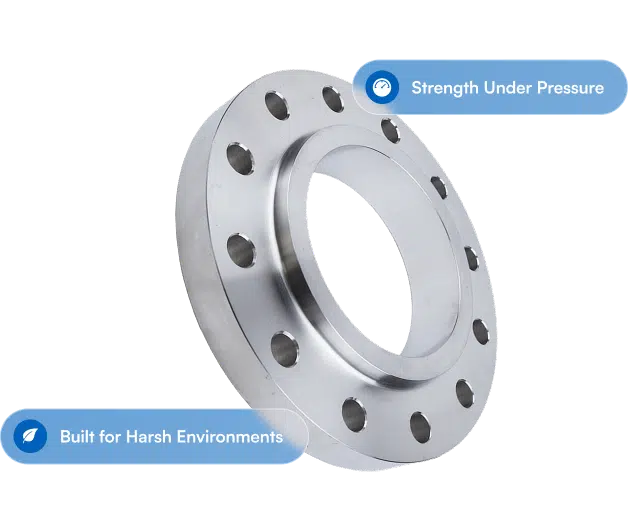
Slip-On vs. Weld Neck Flanges are designed especially for piping systems, providing a reliable means to connect pipes, valves, and other equipment. Among the various types available, Slip-On and Weld Neck flanges are two of the most commonly used.
Each has distinct advantages and applications, making it crucial to choose the right one for your specific needs.
Understanding slip-on flanges
Slip-On flanges are named for their design, which allows them to “slip” over the pipe before welding. They are typically welded both inside and outside to ensure a secure fit. These flanges are easy to install and are commonly used in low-pressure applications where quick assembly is required.
Advantages of slip-on flanges
- Ease of installation: The simple design makes Slip-On flanges easier and faster to install compared to other flange types.
- Lower initial cost: Generally, Slip-On flanges are more affordable than Weld Neck flanges due to their simpler design and lower material usage.
- Versatility: These flanges are suitable for a wide range of applications, including water supply, HVAC, and low-pressure pipelines
Disadvantages of slip-on flanges
- Less structural integrity: Because they are welded externally rather than integrated into the pipe, they are not as strong as Weld Neck flanges.
- Limited pressure handling: Slip-On flanges are best suited for low to moderate pressure applications and may not be ideal for high-stress environments.
- Higher risk of leakage: The double-welding requirement can introduce potential weak points, making these flanges more prone to leaks over time.
Understanding weld neck flanges
Weld Neck flanges, also known as WN flanges, are designed with a long, tapered hub that provides a smooth transition between the flange and the pipe. This design helps distribute stress evenly, making them ideal for high-pressure and high-temperature applications.
Advantages of weld neck flanges
- Superior strength and durability: The tapered hub ensures better load distribution, reducing stress concentration and making them highly durable.
- Excellent pressure and temperature resistance: Weld Neck flanges can withstand extreme conditions, making them suitable for industries such as oil and gas, power plants, and chemical processing.
- Reduced risk of leaks: The full penetration weld provides a stronger connection, minimizing the chances of leaks over time.
Disadvantages
- Higher initial cost: Due to their robust design and the additional material used, Weld Neck flanges are generally more expensive than Slip-On flanges.
- More complex installation: Proper welding and alignment require skilled labor, increasing installation time and cost.
- Space considerations: The long hub takes up more space, which may be a constraint in compact installations.of weld neck flanges
Key differences between slip-on and weld neck flanges
| Feature | Slip-On flange | Weld Neck flange |
| Installation Ease | Easy | Requires skilled welding |
| Cost | Lower | Higher |
| Strength | Moderate | High |
| Pressure Handling | Low to Medium | High |
| Leak Resistance | Moderate | Excellent |
| Applications | Water supply, HVAC, low-pressure pipelines | Oil & gas, high-pressure pipelines, chemical plants |
How to choose between Slip-On vs. Weld Neck flanges
When selecting the right flange type, consider the following factors:
- Operating pressure and temperature: If your system operates under high pressure or extreme temperatures, Weld Neck flanges are the better choice due to their superior strength.
- Budget constraints: If cost is a significant concern and the system operates at lower pressures, Slip-On flanges may be more economical.
- Long-term durability: If you need a long-lasting and reliable connection, Weld Neck flanges offer better longevity.
- Installation requirements: If you require a quick and straightforward installation process, Slip-On flanges are easier to work with.
Which flange should you choose?
Slip-On vs. Weld Neck flanges have their place in industrial applications, and the best choice depends on your specific requirements. If you need a cost-effective solution for low-pressure systems, Slip-On flanges may be the way to go.
However, for high-pressure and high-temperature applications where durability and leak resistance are paramount, Weld Neck flanges are the superior choice.
Discover high-quality flanges at Texas Flange
When it comes to high-quality flanges, Texas Flange is your trusted partner. With decades of experience in manufacturing reliable and durable flange solutions, we offer an extensive range of Slip-On vs. Weld Neck flanges to suit any application. Contact us today to learn more about our products and find the perfect flange for your needs!
FAQ’s
What is the difference between Slip-On and Weld Neck Flanges?
The main difference between Slip-On and Weld Neck flanges lies in their design and method of attachment. Slip-On flanges are designed to slide over the pipe and are welded both inside and outside for a secure connection. This design makes them easier and faster to install but is not as strong as a Weld Neck flange.
Weld Neck flanges, on the other hand, have a long tapered neck that is welded directly to the pipe, providing a stronger and more durable connection, especially in high-pressure or high-temperature applications.
When should I use a Slip-On flange instead of a Weld Neck flange?
Slip-On flanges are typically used in low-pressure applications or where cost and ease of installation are important. They are ideal for situations where welding time and material cost need to be minimized.
Weld Neck flanges are used when strength, durability, and the ability to handle higher pressures and temperatures are crucial. They are often chosen for critical applications in industries like petrochemical, oil, and gas where a reliable, leak-proof connection is required.