Flanges are the unglamorous workhorses of every industrial piping system. You don’t notice them when they work, and you can’t ignore them when they don’t. They’re the reason your refinery can change a valve without cutting pipe, the reason your water utility can pull a pump for service, and the reason a pressure vessel can be inspected and put back into operation without ripping out half a plant.
This is the complete guide. What flanges are, what they do, how they’re built, what types exist, what standards govern them, and how to pick the right one. Texas Flange has been stocking and shipping flanges across ANSI, ASME, API, and AWWA standards since 1986, and the questions in this guide are the same ones our sales engineers field every day.
What Is a Flange?
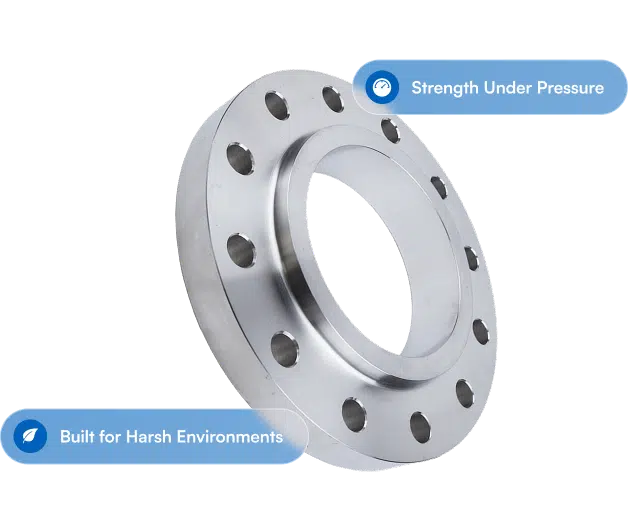
A flange is a forged or cast, disk-shaped fitting that lets two pipe sections, or a pipe and a valve, or a pipe and a vessel, be bolted together rather than permanently welded. The connection is reversible. You can break a flanged joint, service the equipment, and bolt it back up without cutting pipe or grinding welds. That single property is what makes flanges indispensable in industrial piping.
Mechanically, a flange is a ring of steel (or stainless, alloy, nickel, or duplex) with bolt holes around the perimeter and a sealing face in the center. The sealing face mates against a gasket and a matching flange on the other side of the joint. Bolts compress the gasket. The compressed gasket seals the joint. Pressure stays in the pipe.
Flanges are governed by a stack of standards depending on service. ASME B16.5 covers the most common ANSI-class flanges from 1/2 inch through 24 inches. ASME B16.47 covers larger sizes. API 6A covers wellhead and Christmas-tree flanges in the oil and gas upstream sector. AWWA C207 covers steel waterworks flanges. Each standard sets dimensions, materials, pressure ratings, marking conventions, and tolerances.
If you’re shopping flanges, start at our products page. If you need to look up dimensions or weights, the flange dimensions and weights reference has the tables.
Flange Basics
A flange is an external mechanical connection. Two flanges, one gasket, a set of bolts, and the joint is closed. Take the bolts out and the joint comes apart. That reversibility is the whole reason flanges exist instead of just welding everything end to end.
Most industrial flanges are forged carbon steel (ASME SA-105) or forged stainless steel (ASME SA-182, grades F304/L, F316/L). Flanges in higher temperature or corrosion service are made from chrome-moly grades (F11, F22, F91), nickel alloys (Alloy 625, Alloy 825, Hastelloy), or duplex stainless (2205, 2507). Cast iron and ductile iron flanges show up in waterworks and low-pressure utility service. Stainless and exotic alloys handle process, food, pharmaceutical, and offshore applications.
The flange’s job is to take the load of bolt tension and translate it into uniform compression on the gasket, while resisting the internal pressure of the line. That’s a structural problem and a sealing problem at the same time. The standards exist to make sure both problems are solved with predictable, interchangeable parts.
What Flanges Do
Flanges do more than just bolt pipe together. The full job description includes a half-dozen related functions, each of which matters in its own corner of the industry.
Connect Pipes Securely
The headline function. A flanged joint, properly torqued with a properly selected gasket, holds full system pressure indefinitely. Flanges turn a permanent piping system into a serviceable one without sacrificing seal integrity.
Maintain a Tight Seal
Bolt tension creates uniform compression across the gasket face. The gasket deforms to fill machining marks and small surface imperfections, blocking leak paths. Different gasket materials and styles (spiral wound, ring-joint, full-face, soft cut) match different flange face geometries and service conditions.
Enable Inspection and Maintenance
Reversibility is the underrated flange superpower. Need to pull a control valve, swap a strainer, replace a check, recalibrate an orifice plate, hydrotest a section of pipe, or pull a pressure relief valve for certification? Flanged connections make all of that possible without cutting and re-welding pipe. Plants run on this fact.
Handle Cyclic and Thermal Loads
A properly designed flanged joint distributes cyclic mechanical loads (pump pulsations, compressor vibration, thermal cycling) through the bolt circle and gasket without leaking. The bolt preload and gasket selection are what carry the cyclic load. Get the spec right and the joint outlasts the equipment. Long pipe runs that grow and shrink with temperature lean on flanged joints, expansion loops, and proper anchoring to absorb that movement without overstressing the line.
Cover Extreme Service
Cryogenic service down past -320°F (liquid nitrogen) and high-temperature service up past 1,100°F (refinery cat-cracker, ultrasupercritical steam). Flange materials and classes are rated across the full temperature range, with derating tables in ASME B16.5. The same standardized parts cover carbon steel general process, stainless food and pharma, duplex offshore, cast iron water utility, API 6A wellhead, and AWWA waterworks. The catalog is wide because the service envelope is wide.
Join Different Pipe Materials and Sizes
Reducing flanges, transition flanges, and flange-faced reducers let one diameter or material connect to another. Carbon steel pipe to a stainless valve. Six-inch pipe to a four-inch fitting. Without flanges, every transition would be a custom weld with all the documentation that comes with it.
How Flanges Connect
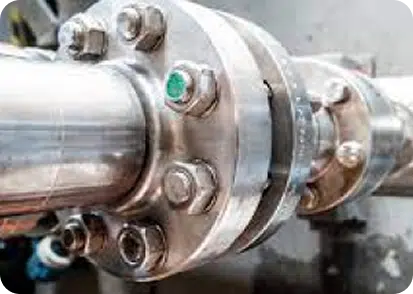
People search “flange connections” and “types of flange connections” enough that the question deserves its own section. The short answer: flanges connect by bolting two matching faces together with a gasket between them, torqued in a controlled cross-pattern sequence.
The longer answer covers what’s bolting to what.
Flange to flange. The most common case. Two matching weld-neck or slip-on flanges, a gasket between, bolts and nuts torqued in a cross-pattern.
Flange to valve. Most industrial valves come with flanged ends in standard ANSI classes. The valve face has the same bolt circle, raised face, and bore as a matching flange. Bolt the valve in place, torque the bolts, gasket seals the joint.
Flange to vessel. Pressure vessels are often flanged at nozzles, manways, and inspection ports. The vessel nozzle is welded with a flange on the end, the cover or piping is bolted to it. Pressure vessel design is governed by ASME Section VIII Division 1, with custom flange design covered in Mandatory Appendix 2.
Flange to fitting. Flanged elbows, tees, reducers, and caps exist for every standard size and class. Used in serviceable spool sections where future maintenance is expected.
Torque sequencing matters. Flange bolts must be tightened in a cross-pattern (also called a star pattern) in multiple passes, bringing all bolts up to roughly 30 percent of final torque, then 60 percent, then 100 percent. This distributes gasket compression evenly. Tightening one side of the bolt circle to full torque before starting the other side warps the joint and causes leaks. If you’re chasing a leak on a fresh joint, start with the torque procedure before blaming the gasket. We have a full breakdown of flange leak causes and fixes if you want to go deeper.
Flange Design Basics
Flange design balances three competing demands: structural strength, sealing geometry, and machinability. ASME B16.5 standardizes the dimensions for the most common cases, but understanding what’s underneath the standard helps you spec smarter.
Flange Components
Every flange has the same core anatomy:
- Hub. The thicker section of the flange that transitions from the bolt-circle face to the pipe bore. Carries the bending stress from bolt load.
- Neck. The tapered section between the hub and the welded end (on a weld-neck flange). The taper provides smooth load transfer into the run pipe and reduces stress concentration at the weld.
- Bore. The internal diameter, machined to match the inside diameter of the mating pipe schedule. Critical on weld-neck and socket-weld flanges.
- Raised face (or flat face / RTJ groove). The sealing surface that contacts the gasket. Geometry depends on face type.
- Bolt circle. The diameter through the centers of the bolt holes. Standardized per ASME B16.5 by size and class.
- Gasket surface finish. A controlled spiral or concentric serration (typically 125-250 microinch AARH) that grips the gasket and resists blow-out.
If you’ve ever opened a flange catalog and wondered why the dimensions are so specific, those tolerances exist because every dimension affects either bolt load distribution, gasket sealing, or weld geometry.
Pressure Vessel Flange Design
Standard ASME B16.5 flanges cover most piping applications, but pressure vessel nozzles, custom heat exchanger heads, and specialty closures often need custom-designed flanges. ASME Section VIII Division 1, Mandatory Appendix 2, governs the design of custom pressure vessel flanges using the Taylor Forge method.
The design process accounts for:
- Operating pressure and temperature
- Bolt-up condition (gasket seating)
- Operating condition (internal pressure plus residual gasket load)
- Hub stress, radial stress, and tangential stress in the flange ring
- Bolt area and bolt material
- Gasket factor (m) and minimum seating stress (y)
A properly engineered Appendix 2 flange will out-spec any standard B16.5 flange of the same nominal size, but it costs more and takes longer to manufacture. Use a B16.5 flange if it meets the service. Move to Appendix 2 only when geometry, pressure, or material requirements push past what the standard offers.
Texas Flange routinely supplies pressure vessel flanges built to customer drawings and ASME Section VIII requirements. If your project has custom pressure vessel work, send the drawings.
Industries That Use Flanges
Flanges show up wherever pipe carries something and somebody needs to take it apart later.
Oil and gas. Upstream wellhead (API 6A), midstream pipelines (ASME B31.4, B31.8), downstream refining (ASME B31.3). One of the biggest consumers of flanges by volume.
Chemical and petrochemical. Stainless and alloy flanges in process service. ASME B31.3 governs the piping code. NACE MR0175 governs sour service material selection.
Power generation. Steam piping, boiler flanges, condensate, feedwater. F11, F22, and F91 chrome-moly grades dominate the high-temperature side.
Water and wastewater. AWWA C207 steel flanges in Class B (most common in distribution), Class D (transmission and pump-station service), and Class E. Different bolt circles than ASME B16.5. Often paired with ductile iron pipe per AWWA C110 / C153.
Food and beverage. Sanitary service. F304L and F316L stainless. Specialty flanges with smooth interior bores and high surface finishes for clean-in-place compatibility.
Pharmaceutical. Similar to food and beverage with even tighter cleanliness and documentation requirements.
Pulp and paper. Heavy-duty service across a corrosive process. Stainless and duplex are common.
Mining and metals. Slurry service, abrasion-resistant materials, often oversized flanges to handle particulate.
General manufacturing. Air, water, hydraulic, and steam utility lines across every kind of plant. Carbon steel B16.5 dominates here.
Flange Pricing in the Current Market
Flange pricing today is a different conversation than it was three years ago. Tariffs, raw material volatility, and the AIS / BABA premium on federally funded infrastructure have all moved the price of getting a flange onto a job site.
For a current breakdown of how trade policy, domestic content rules, and material costs are shaping flange pricing right now, see our flange market and regulations update.
For Texas Flange specifically, we’ve kept stock deep across A105, A350 LF2, F304L, and F316L in standard ANSI classes, plus AWWA C207 Class B and selected API 6A sizes. Domestic-melt-and-manufacture material is in stock for AIS-required projects.
Different Types of Flanges for Various Applications
Six main flange types cover the vast majority of industrial use cases, with two specialty types rounding out the catalog.
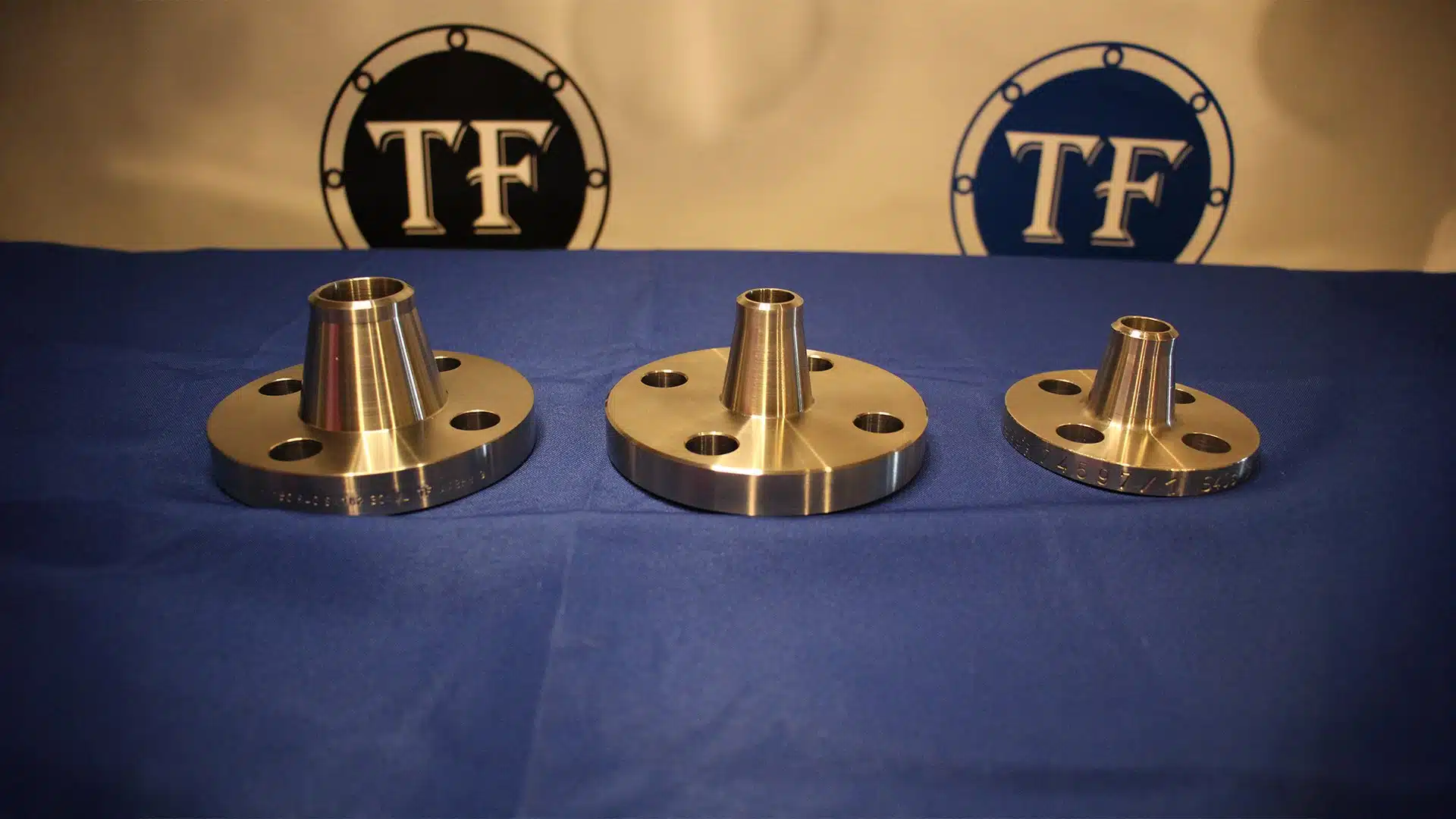
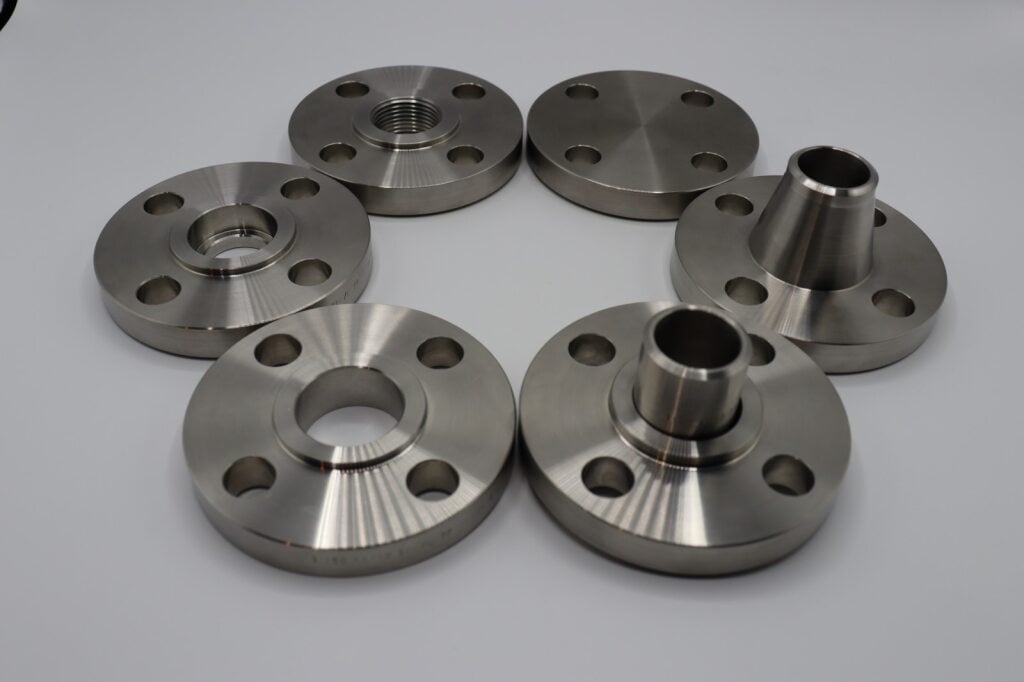
Weld Neck. Tapered hub butt-welded to the run pipe. Best for high-pressure, high-temperature, cyclic, and critical service. Most common in oil and gas, refining, and pressure vessels. Browse weld neck stock.
Slip-On. Slipped over the pipe end and fillet-welded inside and out. Easier alignment than weld neck, lower pressure rating, used in lower-pressure service and waterworks. Browse slip-on stock.
Blind. Solid disc with no bore. Closes off the end of a flanged pipe run. Used at terminations, on inspection ports, and in pressure vessel manways. Browse blind flange stock.
Socket Weld. Pipe slips into a socket bore, fillet-welded externally. Limited to smaller sizes and lower pressures. Common in process piping for instrument lines and small-bore service.
Threaded. Internal NPT threads. No welding required. Used in low-pressure, low-temperature, non-cyclic service. Common in utility lines and small-bore hydraulic and pneumatic.
Lap Joint. Two-piece design: a stub end (welded to the pipe) and a backing flange (free to rotate). Used where bolt-hole alignment is tricky, or where the line material is exotic and a carbon steel backing flange saves money.
Specialty types include Reducing flanges (one nominal size to another in a single flange) and Spectacle Blind / Paddle Blind (positive isolation of a section of line: spectacle is a permanent figure-eight, paddle is removable).
For the deeper breakdown on what fits which job, the flange selection buyer’s guide walks the decision in order.
Different Types of Flange Face
Face type is the geometry of the sealing surface. The mating flange has to have the same face type, or the joint won’t seal.
Raised Face (RF). The default. Face stands proud of the bolt circle by 1/16 inch (Class 150 and 300) or 1/4 inch (Class 400 and above). Concentrates bolt load on the gasket. Most common across ASME B16.5 service.
Flat Face (FF). Full-face gasket, no raised area. Used when bolting to brittle housings (cast iron, fiberglass, low-strength bronze) that would crack under raised-face bolt-up.
Ring Type Joint (RTJ). Metal-to-metal seal using a soft iron, soft steel, or alloy ring in a machined groove. Standard for ASME B16.5 600# and above in high-pressure / high-temperature service, and required for API 6A. Gasket ring per ASME B16.20.
Tongue and Groove (TG), Male and Female (MF). Specialty service where the gasket must be locked in by geometry. Lethal service, hydrogen, and certain process applications.
For the full technical breakdown on raised-face geometry, gasket math, and when to deviate from RF, see the raised-face flange guide.
Flange Classifications and Service Ratings
Three pressure-class systems run the global flange market.
ASME pressure classes. 150#, 300#, 600#, 900#, 1500#, 2500#. These are pound classes, not literal pressure ratings. A 300# flange in A105 carbon steel handles 740 psig at 100°F and 550 psig at 600°F. The pressure-temperature relationship is governed by the ASME B16.5 P-T tables for sizes 1/2″ through 24″, and ASME B16.47 for sizes 26″ through 60″. The P-T tables are published in the standards themselves; ASME does not permit republication.
API 6A pressure classes. 2,000, 3,000, 5,000, 10,000, 15,000, and 20,000 psi. These are literal working pressures for wellhead and Christmas tree equipment. API 6A flanges look similar to B16.5 flanges but have different bolt circles, different bore tolerances, and required RTJ faces. They are not interchangeable with B16.5.
AWWA classes. Class B, Class D, Class E, Class F. Lower-pressure waterworks service, ductile iron pipe interface, large bolt patterns. Class B per AWWA C207 is rated for 86 psi cold working pressure in sizes 4″ through 24″, and 75 psi in sizes 26″ through 144″. Different bolt circles than ASME B16.5 of the same nominal size. They are not interchangeable.
The cardinal rule: pressure class has to match the system class exactly, or be specifically engineered for the transition. You cannot bolt a 150# flange to a 300# flange and expect a sealed joint at any pressure. The bolt circles match in some sizes, but the geometry, bolt load, and gasket compression are designed for different working pressures.
Flange Standards
Flanges are some of the most standards-heavy products in industrial supply. The standards exist because the parts have to be interchangeable across mills, distributors, and contractors. Here are the active revisions you’ll see referenced on a current spec sheet.
- ASME B16.5-2025 – Pipe Flanges and Flanged Fittings: NPS 1/2 through 24, Classes 150 through 2500.
- ASME B16.47-2025 – Large Diameter Steel Flanges: NPS 26 through 60, Series A and Series B.
- ASME B16.20-2023 – Metallic Gaskets for Pipe Flanges: Ring-Joint, Spiral Wound, and Jacketed.
- ASME B16.21-2021 – Nonmetallic Flat Gaskets for Pipe Flanges.
- ASME B16.36-2015 (R2020) – Orifice Flanges.
- ASME SA-105 / SA-182 / SA-350 – Material specifications for forged carbon, stainless, and low-temperature carbon flanges.
- ASTM A961/A961M-24 – Standard Specification for Common Requirements for Steel Flanges, Forged Fittings, Valves, and Parts for Piping Applications.
- API 6A, 21st Edition – Specification for Wellhead and Christmas Tree Equipment.
- AWWA C207 – Steel Pipe Flanges for Waterworks Service, Sizes 4 In. Through 144 In.
- NACE MR0175 / ISO 15156 – Materials for Use in H2S-Containing Environments in Oil and Gas Production.
- AWWA C110 / C153 – Ductile-Iron and Compact Ductile-Iron Fittings.
A note on naming: most of these standards used to be ANSI standards. Over the last twenty-five years, ANSI handed administration to ASME. ANSI B16.5 is now ASME B16.5. Same standard, different administrator.
Mill markings on every legitimate flange should include heat number, size, class, material grade, manufacturer, and standard reference. If the flange shows up unmarked, that’s a red flag, not a discount. For the full breakdown on reading mill paperwork, see the mill test report guide.
Conclusion
Flanges are the connection point that lets industrial piping be built, serviced, expanded, inspected, and rebuilt without tearing the system apart. They come in a half-dozen face types, six common body types plus specialty variants, three pressure-class systems, and dozens of material grades, all governed by an interlocking set of ASME, ASTM, API, AWWA, and NACE standards.
The right flange for any project is the one that matches the service medium, the operating pressure and temperature, the code of construction, the mating component, and the documentation requirements. Pick the wrong one and you’re rebuying. Pick the right one and the joint outlasts the equipment.
Texas Flange has been answering “what flange do I need” questions since 1986, with stock depth across ANSI, ASME, API, and AWWA standards, in 50+ material grades, and AIS-compliant material in stock for federal projects. If the spec is messy, send it. If it’s clean, request a quote and we’ll get it back to you fast.

FAQs
What is a flange used for?
A flange is used to connect two pipe sections, or a pipe and a valve, or a pipe and a vessel, in a way that can be unbolted and reassembled. The reversibility is what makes industrial piping serviceable.
What is the difference between a flange and a fitting?
A flange is specifically a bolted connection point with a gasket. A fitting is a generic term for any pipe component (elbow, tee, reducer, cap) used to change direction, branch, or close off a line. Flanges and fittings are sometimes combined (a flanged elbow, for example), but the terms aren’t interchangeable.
What materials are flanges made from?
The most common are forged carbon steel (ASME SA-105) and forged stainless (SA-182, F304/L, F316/L). Beyond those: A350 LF2 for low-temperature carbon, F11 / F22 / F91 chrome-moly for high temperature, Alloy 625 / 825 / Hastelloy for corrosive service, and 2205 / 2507 duplex for high-strength corrosion-resistant applications. The flange selection guide walks through which material fits which service.
What’s the highest-pressure flange you can buy?
Per ASME B16.5, the top class is 2500#. For higher pressures, you move to API 6A wellhead flanges, rated up to 20,000 psi. Beyond 20K, you’re in custom-engineered territory and you need a sales engineer on the call before the order goes through.
Are RF and FF flanges interchangeable?
No. Bolting a raised-face flange to a flat-face component will crack the FF component if it’s brittle (cast iron, fiberglass). Match the face type to the mating component, or use a transition spool.
Do I need an MTR for my flange order?
If the project spec calls for one, yes. ASME B31.3 process piping, API 6A wellhead, and most government-funded infrastructure require MTRs. Texas Flange supplies MTRs on request at no extra charge for stock material. Ask on the PO, not after the flange is welded into the line.
What is the difference between ANSI and ASME flange standards?
Same standards, different administrators. ANSI handed administration of the flange standards to ASME over the last twenty-five years. A current ASME B16.5 flange is what people still casually call an “ANSI flange.” Dimensions are identical.
How do I know what gasket goes with my flange?
Gasket selection follows from face type, pressure class, temperature, and service. Spiral wound (per ASME B16.20) for raised face. Ring joint (also B16.20) for RTJ. Soft cut or full-face for flat face. The gasket has to be rated for the service temperature and pressure, not just match the bolt circle.”]}
📞 Contact our team today for expert guidance on your next flange order.
Last updated: May 7, 2026.