The End of the Line: A Comprehensive Guide to Blind Flange Types and Variations
The Unsung Heroes of Pipeline Safety
When you think about the critical components in your piping system, blind flanges probably aren’t the first thing that comes to mind. They’re just flat pieces of metal that bolt onto the end of a pipe, right? Well, yeah, but that’s like saying a pressure relief valve is “just a spring with a disc on it.”
The truth is, blind flanges are some of the hardest-working components in your system. They’re the workhorses that terminate flow during pressure testing, provide access points for future expansion, and create absolute barriers during maintenance shutdowns. When you need to guarantee zero flow, whether you’re isolating a section for repair or permanently capping a line, the blind flange you choose can mean the difference between a safe operation and a catastrophic failure.
So let’s dive into what makes these “simple” components so critical, and more importantly, how to choose the right one for your application.
The Workhorse: Standard B16.5 Blind Flanges
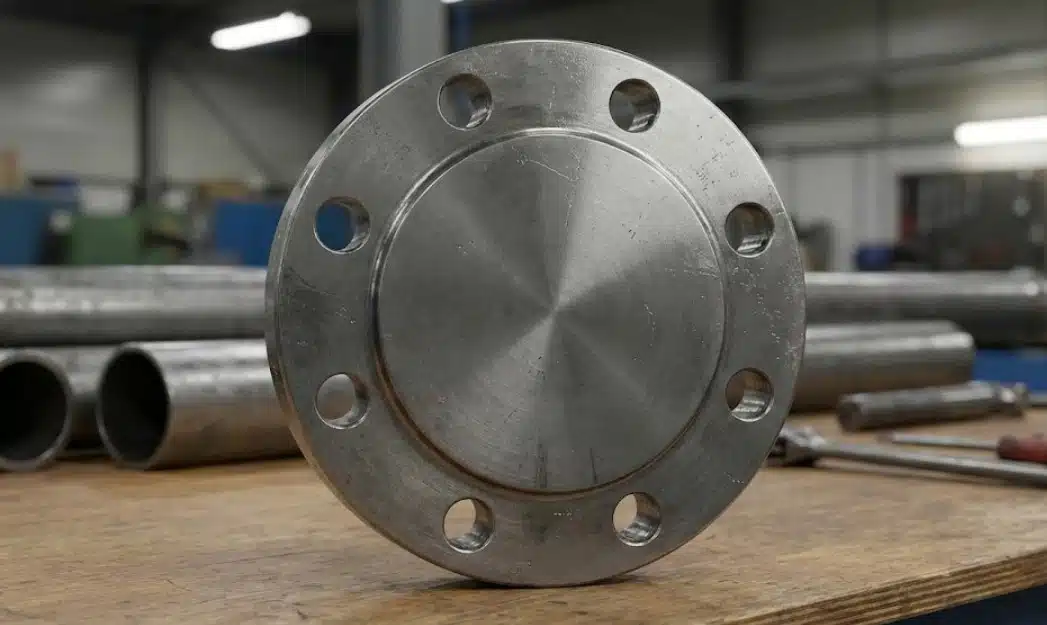
At its core, a blind flange does exactly what the name suggests: it blinds off the end of a piping system. You bolt it to a mating flange, and boom, you’ve terminated flow. But here’s where things get interesting from an engineering standpoint.
Unlike a standard weld neck or slip-on flange that has a hole in the middle, a blind flange takes the full brunt of system pressure across its entire face. Think about it: when you’ve got 600 psi pushing against a 12-inch blind, that’s roughly 68,000 pounds of force trying to blow that disc right off the pipe. That’s why blind flanges are significantly thicker than their open-bore counterparts, they need that beef to resist the massive bending stress concentrated at the center.
Why Thickness Matters
The ASME B16.5 standard (which covers pipe flanges and flanged fittings NPS 1/2 through NPS 24) specifies minimum thickness requirements based on pressure class. A Class 150 blind flange might be 3/8″ thick in smaller sizes, while a Class 2500 blind in the same nominal size could be several inches thick. This isn’t overengineering, it’s physics.
When pressure loads that center section, it wants to deflect like a trampoline. The thicker the material, the better it resists that deflection and the resulting stress. We see folks try to cut corners by using a lower pressure class blind than their system requires, and that’s a recipe for disaster. Always match or exceed your system’s pressure rating.
Beyond the Basics: Spectacle Blinds and Line Blinds
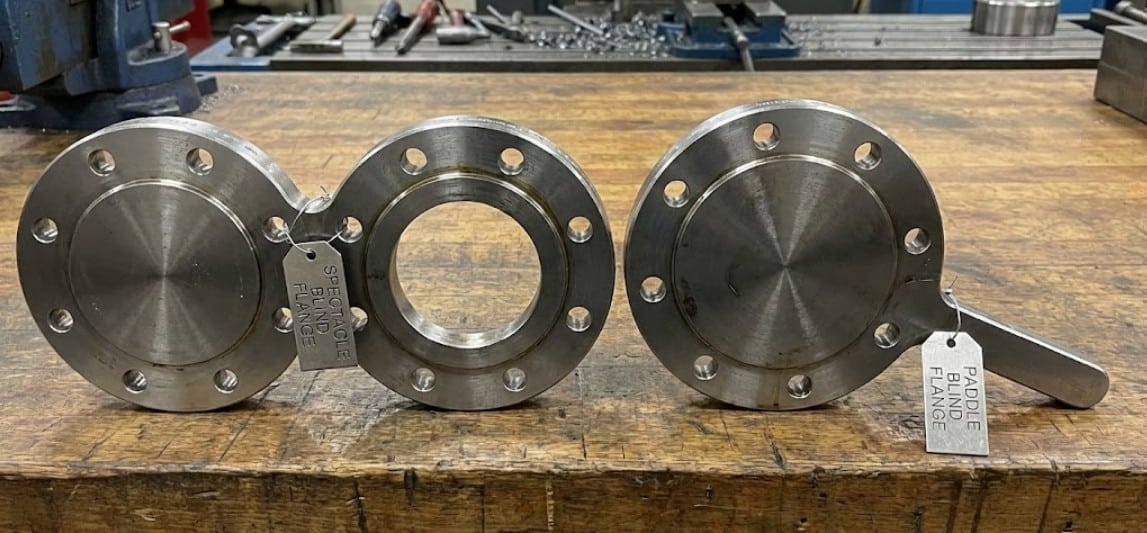
Now, let’s talk about blind flanges’ specialized cousins: spectacle blinds (also called figure 8 blinds) and paddle blinds. These are designed specifically for situations where you need to switch between flow and positive isolation without completely removing hardware.
Spectacle Blinds (Figure 8s)
A spectacle blind looks like a pair of glasses, hence the name. One end is a solid plate (the blind), and the other end has an opening (the spacer). The whole assembly rotates around a central pivot point between two flanges. When you need flow, you rotate the open end into position. When you need isolation for maintenance, you rotate the blind end into position.
This is what we call “positive isolation” in the industry. Unlike a valve (which can leak internally or be accidentally opened), a spectacle blind provides a physical barrier. You can literally see which position it’s in, and there’s no way for pressure to bypass it. This is crucial for maintenance safety, especially in hazardous services.
Paddle Blinds and Spacers
Paddle blinds are the simpler version, just a circular blind on one end of a handle. They work the same way as spectacle blinds but are typically used in smaller lines where a full figure 8 would be overkill. Spacers are the opposite: they’re just the open ring, used to maintain proper bolt length when the blind isn’t in service.
Here’s a pro tip: always order the correct thickness spacer to match your blind. If they’re not identical thickness, you’ll have bolting issues when you rotate between positions.
Technical Deep Dive: Standards That Matter
Let’s get into the weeds for a minute because understanding the standards will save you headaches down the road.
ASME B16.5 vs. ASME B16.48
Most standard blind flanges fall under ASME B16.5, which covers the flanges we use every day in piping systems. But when you’re dealing with spectacle blinds, paddle blinds, and spacers specifically designed for line isolation, you’re looking at ASME B16.48 territory, the standard for line blanks.
B16.48 is more specific about:
- Handle design and marking requirements
- Material specifications for isolation applications
- Installation orientation and safety considerations
- Proper thickness calculations for the blind portion
Both standards are critical, but here’s the key: your spectacle blind needs to match the pressure class and facing type of the flanges it’s going between. A Class 300 RF spectacle blind won’t work properly between Class 150 flanges, and vice versa.
Material Matters
Whether you’re using B16.5 or B16.48 components, material selection is crucial. Common materials include:
- Carbon Steel (A105/A105N): Your workhorse for general service
- Stainless Steel (304/304L, 316/316L): Corrosion resistance for chemical service
- Alloy Steel (F11, F22): High-temperature applications
- Duplex/Super Duplex: Aggressive corrosion environments
Always verify that your blind flange material is compatible with your process fluid and temperature. Using carbon steel in acidic service is asking for trouble, no matter how thick that blind is.
Texas Flange Capabilities: Custom Solutions for Real-World Problems
This is where we get to talk about the solutions we provide every day at Texas Flange. Because while standard blinds handle most applications, there are plenty of situations where you need something more specialized.
Tapped Blinds: Adding Functionality
One of the most common custom requests we get is for tapped blinds. Here’s the scenario: you’re pressure testing a new line, or you need to monitor pressure in a dead leg, or you want to install a drain valve at a low point. Instead of adding an entire flanged connection, we can machine NPT threads right into the center of your blind flange.
Common tapping configurations include:
- 1/4″ NPT: Perfect for pressure gauges or small vent valves
- 1/2″ NPT: Standard for drain connections
- 3/4″ NPT and larger: When you need significant flow capacity
We can tap blinds from the smallest sizes up through 24″ and larger. The key is ensuring there’s enough material thickness to provide adequate thread engagement without compromising the structural integrity of the blind. That’s where our engineering team comes in, we’ll verify that your custom tapped blind meets all code requirements.
High Hub Blinds: When Standard Won’t Cut It
As you get into larger sizes and higher pressure classes, you’ll sometimes encounter high hub blinds. These feature an extended hub section (similar to a weld neck flange) that provides additional reinforcement where the blind connects to the bolt circle.
High hub blinds are typically used when:
- You’re working with large-diameter, high-pressure applications
- The standard blind thickness would be impractically heavy
- You need better stress distribution at the flange connection
Think of it as distributing the load more efficiently. Instead of all that stress concentrating at the bolt holes, the hub helps transfer it more gradually into the flange body.
Face Finish: RF vs. FF (This Matters More Than You Think)
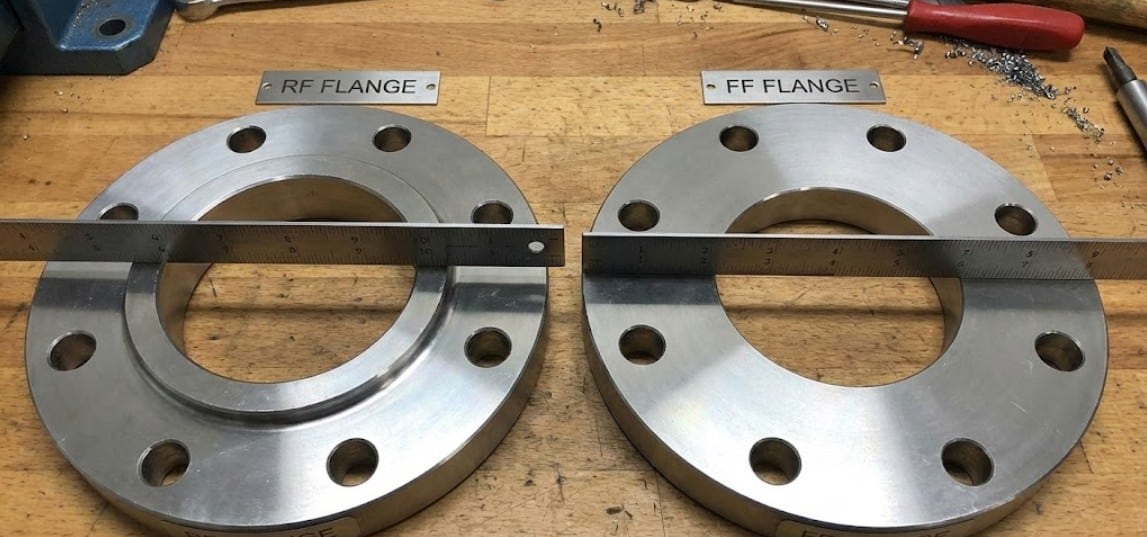
Here’s something that trips people up constantly: raised face (RF) versus flat face (FF) blinds. Most steel flanges are RF, they have a small raised section around the bolt circle that concentrates the gasket load. But many cast iron components (like pump housings or valve bodies) are FF because cast iron can crack under concentrated loads.
If you bolt an RF blind to a FF flange (or vice versa), you’re either:
- Creating a gap that will leak (RF blind on FF flange with inadequate gasket compression)
- Cracking your equipment (RF blind crushing a cast iron FF flange face)
We stock both configurations, and we always verify which facing type you need before shipping. It’s a simple detail that prevents expensive failures.
Common Mistakes We See (and How to Avoid Them)
After decades in this business, we’ve seen pretty much every mistake possible with blind flanges. Here are the most common ones:
Underestimating Weight
A 24″ Class 300 blind flange weighs around 215 pounds. A 24″ Class 600? Try 430 pounds. These aren’t components you hand-carry to the job site. Plan for proper rigging and lifting equipment, especially on larger sizes. We’ve seen too many back injuries from folks trying to manhandle blinds that need proper material handling equipment.
Confusing Test Flanges with Permanent Blinds
Test flanges (temporary blinds used during hydrostatic testing) and permanent service blinds might look similar, but they’re not interchangeable for long-term service. If your specification calls for a permanent blind, make sure that’s what you’re getting, not a lighter-duty test component.
The Two-Gasket Problem
Here’s one that catches people with spectacle blinds: you need gaskets for both sides. The spacer side and the blind side. When you rotate that figure 8, whatever side goes out of service still needs a gasket to seal against. We’ve had customers call us confused about why they’re leaking, only to find out they installed the blind without a gasket on one side.
Wrong Bolt Length
When you’re switching between blind and spacer positions on a spectacle blind, your bolt length needs to accommodate both configurations. Too short, and you don’t get enough thread engagement. Too long, and you’re bottoming out before proper torque. Calculate your required bolt length based on the thicker of the two positions.
Ignoring Thermal Expansion
In high-temperature service, that blind flange is going to expand. If you’ve got a tapped blind with instrumentation, make sure your gauge or valve can handle the thermal cycling. And always account for the differential expansion between the flange material and your bolting.
Conclusion: Simple Components, Critical Choices
Blind flanges might seem straightforward on the surface, but as we’ve covered, there’s a lot more to them than just “that flat thing that bolts on the end.” From understanding the massive stress they undergo to selecting the right configuration for your specific application, these components demand respect and proper specification.
Whether you need a standard ASME B16.5 blind for permanent termination, a B16.48 spectacle blind for safe maintenance isolation, or a custom tapped blind for pressure monitoring, the key is matching the component to your actual requirements, not just what’s cheapest or fastest to get.
Remember: blind flanges are your last line of defense against leaks, overpressure, and safety incidents. Choose wisely, specify completely, and never compromise on quality.
Get the Right Blind Flange for Your Application
At Texas Flange, we’ve been providing industrial flanges and piping components for decades. Whether you need a standard 2″ Class 150 blind or a custom-tapped 24″ high hub blind in exotic alloys, we’ve got the inventory, engineering expertise, and manufacturing capabilities to deliver exactly what your project demands.
Our team understands that every application is different. That’s why we don’t just take orders, we partner with you to ensure you’re getting the right component for your specific pressure, temperature, and service conditions.
Ready to spec your next blind flange? Contact Texas Flange today for a quote. Give us your size, pressure class, material requirements, and any custom features you need. We’ll make sure you get components that meet code, arrive on time, and perform flawlessly in service.
Because at the end of the line, quality matters.