Ordering the correct flange for your piping system is more than a simple transaction—it’s a precise process that can significantly impact the performance and safety of your equipment. Unfortunately, mistakes in an ASME flange order are all too common, often leading to costly downtime, failed inspections, or compromised integrity.
Why Precision Matters in Flange Procurement
Every detail in a flange order matters. From pressure class and facing to bolt pattern and material, even small errors can delay projects or result in dangerous system failures. Understanding how to avoid the most frequent mistakes in ASME flange orders is key to achieving a reliable and compliant installation.
Mistake #1: Selecting the Wrong Flange Type
Overview of Flange Types and Their Functions
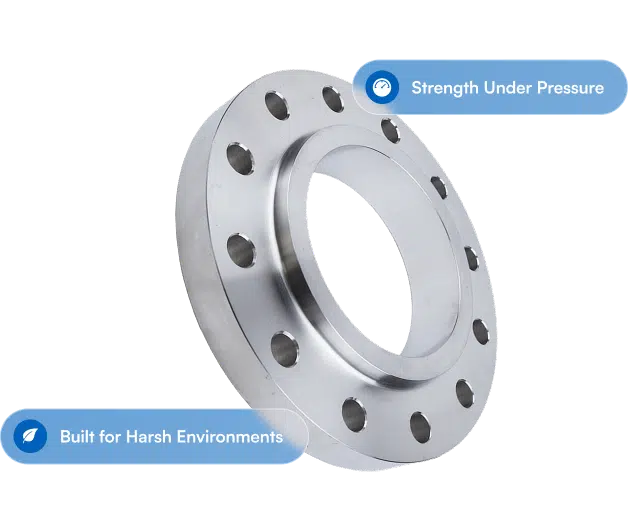
Not all flanges serve the same purpose. Choosing a slip-on flange instead of a weld neck, or getting a slip-on instead of a socket weld, are common mistakes in ASME flange orders when the flange type isn’t specified. Each flange type has a specific function depending on pressure, alignment, and system design.
When transitioning from DIN or ANSI Flanges to ASME, it’s crucial to confirm compatibility by designing your own dimensions and checking with an engineer to run calculations. . Flange dimensions and tolerances vary by standard, and improper substitution can compromise system fit or safety.
For applications involving high pressure or elevated temperatures, a ring joint face flange may be the appropriate choice due to its superior sealing performance.
Mistake #2: Incorrect Pressure Class
Why Pressure Rating Is Crucial
Another critical mistake in ASME flange orders is failing to match the correct pressure class to your system requirements. Flange ratings—150, 300, 600, and beyond—are not interchangeable. A lower-rated flange in a high-pressure line could fail catastrophically.
Reference to ASME B16.5 Standards
All ASME flanges should conform to ASME B16.5, the governing standard that defines flange dimensions, pressure-temperature ratings, and tolerances. Ignoring this can lead to non-compliant installations or rejected inspections.
Mistake #3: Not Specifying the Right Material
Misconceptions Around “Default” Materials
Assuming all flanges come in standard carbon steel is a frequent mistake in ASME flange orders. Applications in chemical processing, marine environments, or high-temperature systems may require stainless steel, nickel alloys, or duplex materials.
Material choice affects not just durability but also corrosion resistance and compliance with environmental or safety regulations. Be specific—don’t leave the material decision to chance.
Mistake #4: Failing to Match the Bolt Pattern
Real-World Error Scenario
Even when the flange type and pressure class are correct, mismatched bolt patterns are a frequent issue. This happens especially when mixing ANSI flanges with ASME or DIN components, as the number and spacing of bolt holes may differ.
Overlooking this small detail in an ASME flange order can delay installation or require costly field modifications. Always double-check the bolt circle diameter and hole configuration against your mating flange or system drawing.
Mistake #5: Overlooking Tolerances or Facing Finish
Raised Face, Flat Face, RTJ. What’s the Difference?
A critical detail that’s often ignored is the facing finish. Whether you need a raised face (RF), flat face (FF), or ring-type joint (RTJ) can drastically impact sealing performance and compatibility with gaskets. Misidentifying this requirement is a costly mistake in ASME flange orders, especially in systems requiring high-integrity seals.
For more technical information, visit the ASME flange guide provided by Texas Flange.
Bonus Tips for a Flawless Flange Order
Double-Checking ASME Compliance
Before finalizing any flange order, verify that all components meet ASME B16.5 standards. Non-compliant products may not pass regulatory inspections or function reliably in high-stress environments.
Working With a Verified Supplier
The most effective way to avoid mistakes in ASME flange orders is to partner with a reputable supplier. A knowledgeable team can guide you through flange selection, material specification, and pressure rating verification.
Conclusion
Minimize Costly Delays With Proper Flange Planning
Avoiding the most common mistakes in ASME flange orders is not complicated—it just requires attention to detail, technical knowledge, and reliable sourcing. By selecting the correct flange type, pressure class, material, bolt pattern, and face finish, you can ensure smooth procurement and optimal system performance.
Need help specifying the right ASME flange? Trust the experts at Texas Flange. Browse our complete selection of ASME flanges, or learn more about specialized options like ring joint flanges. Our team can help you avoid costly errors and deliver exactly what your project requires.