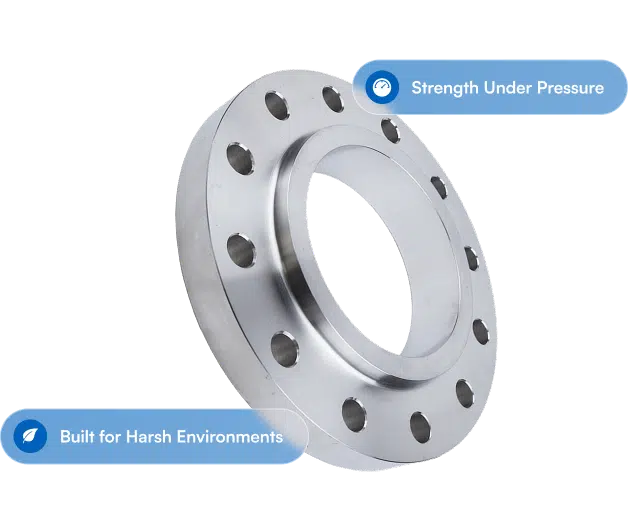
Weld neck vs. threaded flanges are essential components in piping systems, enabling secure connections between pipes, valves, and other equipment.
Among the various types available, weld neck flanges and threaded flanges stand out due to their specific applications and advantages. Understanding their differences and the best use cases for each can help in selecting the right flange for any given project.
What are weld neck flanges?
Weld neck flanges (WN flanges) are characterized by a long, tapered hub that gradually merges with the connected pipe. This design allows for smooth stress distribution, reducing the risk of failure under high-pressure and high-temperature conditions.
Key features of weld neck flanges
- Tapered hub: The extended neck reinforces the connection, reducing stress concentrations.
- Butt weld connection: Provides a robust joint, ensuring leak-proof performance.
- Ideal for high-pressure applications: Often used in industries like oil and gas, power plants, and chemical processing.
- Reduced turbulence and erosion: The smooth transition minimizes turbulence in the flow, which is critical for high-velocity fluid transport.
Best uses for weld neck flanges
- High-Pressure Systems: Ideal for pipelines that operate under high pressure.
- Extreme Temperatures: Suitable for cryogenic and high-temperature applications.
- Corrosive Environments: Used in chemical industries where corrosion resistance is crucial.
- Large-Diameter Piping: Commonly found in large-scale industrial piping systems.
What are threaded flanges?
Threaded flanges (also known as screwed flanges) are designed with internal threads that allow them to be screwed onto pipes with matching external threads. This eliminates the need for welding, making them convenient for applications where welding is impractical or hazardous.
Key features of threaded flanges:
- Screw Connection: Allows for easy installation and removal without welding.
- No Welding Required: Ideal for explosive or flammable environments where welding poses a risk.
- Suitable for Low-Pressure Applications: Typically used in low-pressure and non-critical systems.
- Standardized Threading: Compatible with various pipe sizes and thread types.
Best uses for threaded flanges:
- Low-Pressure Piping: Commonly used in small-diameter, low-pressure applications.
- Hazardous Environments: Perfect for settings where welding could pose a fire or explosion hazard.
- Temporary or Maintenance-Heavy Systems: Used in systems that require frequent disassembly and reassembly.
- Water and Air Piping: Ideal for plumbing and compressed air systems where high pressure is not a concern.
Key differences between weld neck vs. threaded flanges
Understanding the distinctions between weld neck and threaded flanges can help in selecting the right option for specific applications.
| Feature | Weld neck flanges | Threaded flanges |
| Connection Method | Butt weld | Screw/thread |
| Pressure Suitability | High pressure | Low pressure |
| Installation | Requires welding | No welding needed |
| Strength & Durability | High | Moderate |
| Best for | High-pressure, high-temperature, and large-scale piping | Low-pressure, small-diameter, and hazardous environments |
Choosing the right flange for your application
Selecting between a weld neck vs. threaded flanges depends on several factors, including pressure requirements, environmental conditions, and ease of installation.
- Choose weld neck flanges if: You need a robust, leak-proof connection for high-pressure and high-temperature applications. They are best for critical piping systems requiring durability and strength.
- Choose threaded flanges if: You need a quick and easy installation for low-pressure applications, particularly in environments where welding is not feasible.
Find the right flange with Texas Flange
Whether you need weld neck flanges for high-pressure applications or threaded flanges for convenient installation, Texas Flange has you covered.
We offer a wide selection of high-quality of weld neck vs. threaded flanges designed to meet industry standards and ensure optimal performance. Explore our products today and find the perfect solution for your piping needs!
FAQ’s
What is the main difference between Weld Neck and Threaded Flanges?
The primary difference lies in their connection method. Weld Neck flanges are designed to be welded to a pipe, providing a strong and leak-proof connection suitable for high-pressure and high-temperature applications.
In contrast, Threaded flanges have internal threads that allow them to be screwed onto a pipe without welding, making them ideal for low-pressure systems or applications where welding is not feasible.
When should I use a Weld Neck flange instead of a Threaded flange?
A Weld Neck flange is recommended for high-pressure, high-temperature, or critical applications where a strong and reliable connection is required, such as in petrochemical, oil, and gas industries.
A Threaded flange, on the other hand, is suitable for low-pressure applications, temporary setups, or environments where welding is impractical, such as in explosive atmospheres where welding could pose a hazard.
Related reading: For the full six-decision walkthrough on choosing the right flange, see our flange selection guide.