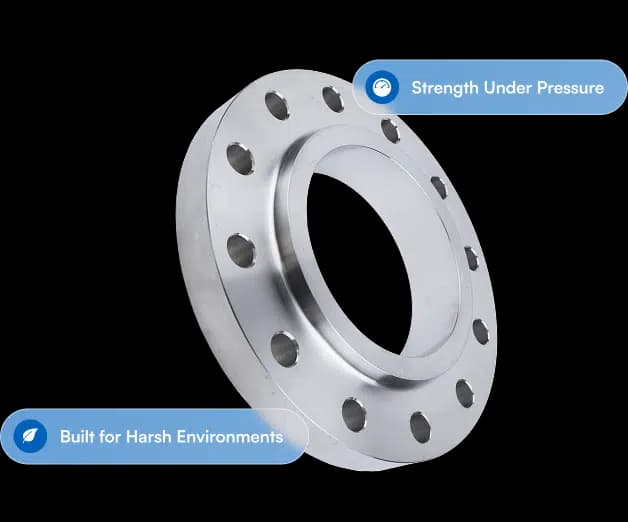
High-Pressure Flange Requirements
High-pressure systems, typically defined as Class 600 and above (Class 900, 1500, 2500), demand flanges with exceptional strength and reliability. These systems operate at pressures from 600 psi to over 2500 psi, requiring every component to be precisely engineered and manufactured to exacting standards. The fundamental requirement is that flanges must maintain their seal under the maximum design pressure without leaking, without plastic deformation, and without fatigue failure over the equipment's operational life. Secondary requirements include thermal stability at elevated temperatures, corrosion resistance in specific service fluids, and compatibility with the piping materials and bolting systems.
High-pressure flange selection is not a simple commodity decision. Each flange type (weld neck, blind, orifice, etc.) has distinct advantages and limitations at high pressure. The correct choice depends on the specific application, the fluid being piped, the operating temperature, the expected duty cycle, and the maintenance philosophy of the facility. Choosing the wrong flange type for high-pressure service risks catastrophic failure and is never advisable.
Weld Neck Flanges for High Pressure
Weld neck flanges are the primary choice for high-pressure piping systems because they provide the most robust connection between the flange and the pipe. The tapered neck of a weld neck flange gradually transitions from the pipe diameter to the larger flange body, creating a reinforced joint that distributes stresses evenly. When welded to carbon steel or alloy steel pipe, this connection provides exceptional strength and reliability. The welded joint creates a permanent, leak-proof connection that cannot separate or rotate.
For Class 600 and 900 applications, weld neck flanges are essentially standard. The flange body is thicker than lower pressure classes, the bolt circle is larger to accommodate larger bolts, and the flange diameter is more substantial to handle the higher stresses. For Classes 1500 and 2500, weld neck flanges remain the preferred choice, though engineering considerations become more complex. The weld neck design is proven in thousands of high-pressure installations across refineries, petrochemical plants, and power stations. When high pressure service is required and money is not a constraint, weld neck flanges are the safe choice.
Blind Flanges Under Pressure
Blind flanges in high-pressure systems demand special consideration because they must withstand the full system pressure on one side with no internal support. A blind flange on a 2-inch Class 2500 system must support over 5000 pounds of force trying to separate the flange from the piping system. The thickness required for a blind flange increases dramatically with pressure class, more so than for through flanges like weld necks.
Blind flanges for high pressure are typically larger in diameter and significantly thicker than equivalent through flanges. The material must be selected carefully to ensure adequate yield strength at operating temperature. Some high-pressure blind flanges are manufactured from ASTM A182 alloy steel rather than carbon steel A105 to provide better strength-to-weight ratio. The bolting on a blind flange must be exceptional, with heavy-duty studs and nuts. Blind flange installation in high-pressure service also requires careful attention to bolt torque and proper seating of the gasket, as any leakage past the seal can be dangerous.
Orifice Flanges in HP Service
Orifice flanges in high-pressure service require specialized engineering. While standard Class 150 or 300 orifice flanges are common in measurement applications operating at modest pressures, high-pressure flow measurement requires Class 600 or higher orifice flanges. These flanges must maintain their integrity under high pressure while still accommodating the pressure tap connections to differential pressure instruments.
The orifice plate itself becomes a critical component in high-pressure service. The plate must be manufactured from material compatible with the flowing fluid and must be thick enough to prevent deflection under pressure. The orifice bore must be precisely sized to avoid excessive pressure drop that wastes energy or creates measurement inaccuracy. High-pressure orifice flange systems should include block and bleed valves on the pressure taps to safely isolate the differential pressure transmitter during maintenance or system upset conditions.
Material and Class Selection
For high-pressure service above 600 psi, material selection becomes critical. ASTM A105 carbon steel is acceptable for most Class 600 and 900 applications up to about 400 degrees Fahrenheit. At higher temperatures or pressures, ASTM A182 alloy steel becomes necessary. A182 F11 (chromium-molybdenum steel) is widely used for Class 1500 service, providing superior strength at elevated temperatures. A182 F22 with higher molybdenum content is used for Classes 2500 and above, and also for sustained high-temperature service where creep resistance is important.
The pressure class itself must be carefully selected based on the actual maximum operating pressure. System transients like pressure spikes from valve closure must be considered. Many facilities specify one pressure class higher than the calculated maximum pressure to provide a safety margin. For example, if the system maximum pressure is 900 psi, specifying Class 1500 flanges provides significant design margin. This margin provides protection against unforeseen pressures and extends component life.