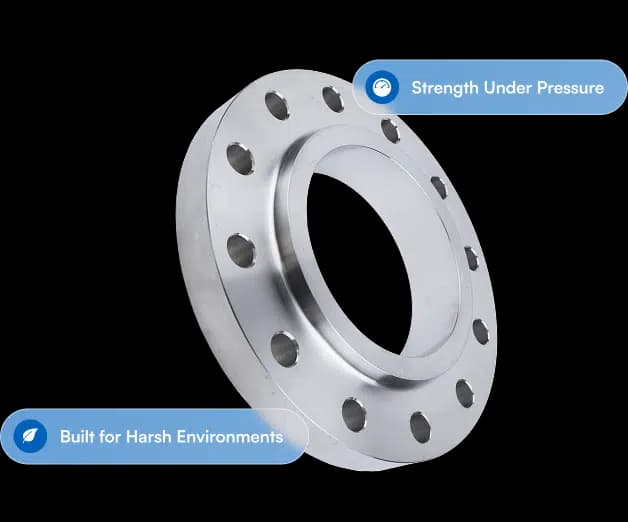
What Is an Orifice Flange?
An orifice flange is a specialized type of flange equipped with integral tapping points that allow installation of differential pressure instruments. The flange features small ports or taps on its body and sometimes on the raised face area, positioned both upstream and downstream of where an orifice plate would be installed. These taps connect to instruments that measure the pressure difference created by the orifice plate, which in turn provides a measurement of the fluid flow rate passing through the pipe.
Orifice flanges eliminate the need for separate drilling and tapping operations on standard flanges, making them purpose-built for flow measurement applications. They're typically welded into the piping system in pairs, one on each side of the orifice plate, and the taps are connected to transmitters that send signals to control systems or directly to flow meters. The design is standardized under ASME B16.36, which specifies dimensions, tap locations, and thread types.
How Orifice Flanges Work
When fluid flows through a pipe and encounters an orifice plate (a thin metal plate with a precisely sized opening), the fluid velocity increases as it passes through the restricted opening. This acceleration creates a pressure drop. The magnitude of the pressure drop is proportional to the square of the flow rate, which makes it a reliable basis for measuring flow. Orifice flanges provide convenient connection points to capture this pressure differential.
The upstream tap, located between the two orifice flanges, senses the pressure before the fluid reaches the restriction. The downstream tap, typically located about one pipe diameter after the orifice plate, senses the lower pressure on the outlet side. The differential pressure transmitter compares these two pressures and generates an electrical signal that's proportional to the flow rate. This principle is used in millions of industrial flow measurement applications worldwide, making orifice flanges fundamental to process control, custody transfer, and system monitoring.
Tap Configurations
Orifice flanges come in several standard tap configurations, each suited to different measurement scenarios. The most common configurations are vena contracta taps, flange taps, and pipe taps. Vena contracta taps are typically located one pipe diameter upstream and half a pipe diameter downstream, capturing the pressure differential exactly where the pressure drop is maximum. This configuration provides the most accurate measurement and is preferred in custody transfer applications where measurement accuracy directly affects revenue.
Flange taps are located directly on the orifice flanges themselves, usually bored into the flange body at standardized locations. This configuration is convenient for installation since everything is integrated into the flange, reducing field fabrication. Pipe taps are located one full pipe diameter upstream and downstream, offering slightly less accuracy than vena contracta taps but still providing good performance. The choice between configurations depends on your accuracy requirements, available space, and whether you're performing billing-quality custody transfer measurements or standard process monitoring.
When to Specify Orifice Flanges
Orifice flanges should be specified whenever your application requires flow measurement through an orifice plate restriction. Common applications include natural gas measurement at custody transfer points, liquid petroleum product measurement, compressed air and steam flow monitoring in industrial facilities, and water flow measurement in municipal systems. Custody transfer applications are particularly important because they often involve significant financial transactions, making measurement accuracy critical.
Orifice flanges are also valuable in situations where you need to intentionally create a pressure drop to control or regulate flow, though this is less common than their use in measurement. The pressure drop created by an orifice can serve as a flow restrictor in certain system designs. However, this intentional use of an orifice flange must be carefully calculated to avoid excessive energy waste. Many facilities have discovered that upgrading from taped standard flanges to integrated orifice flanges dramatically improves the reliability and accuracy of their flow measurements.
Sizing and Ordering
When ordering orifice flanges, you need to specify the pipe size, pressure class, material, and bore type (raised face or ring joint) just like standard flanges. Additionally, you must specify the tap configuration (flange taps, vena contracta, or pipe taps) and the thread size for the taps, typically 1/4 or 1/2 inch NPT. Some manufacturers offer orifice flanges with pre-drilled taps that are test plugged during manufacturing, which reduces field preparation.
The orifice plate itself is designed separately from the flange and is custom fabricated based on your flow measurement requirements. The orifice diameter is calculated using flow measurement equations and standards like ISO 5167, which considers the pipe diameter, expected flow rate, and fluid properties. Never guess at orifice sizing since an incorrect diameter will produce meaningless measurements. Work with your process control engineer or flow measurement specialist to calculate the required orifice diameter, then order a custom orifice plate to that specification along with your orifice flanges.