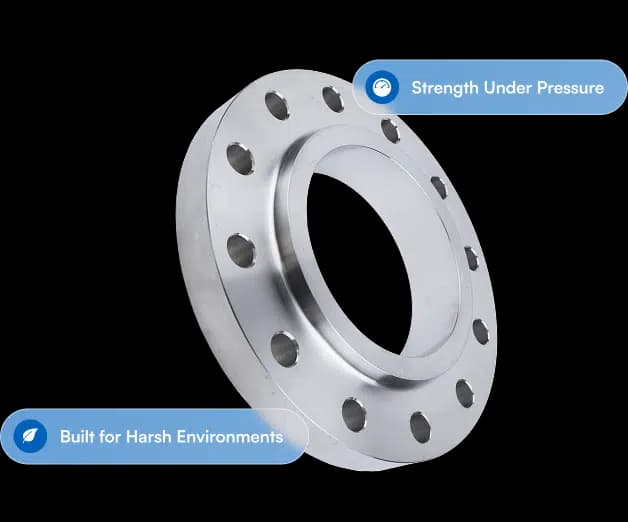
What Is a Raised Face Flange?
A raised face (RF) flange is a flange with a circular protruding surface in the center of the flange face where the gasket sits. The raised face is a separate ring machined from the main flange body, typically 1/16 to 1/4 inch in height depending on the flange size and pressure class. When two RF flanges are bolted together, the gasket sits between the two raised faces, creating a confined area that provides more effective sealing than a flat surface.
The engineering principle behind the raised face is that confining the gasket to a smaller diameter creates higher bearing stress on the gasket, which helps maintain the seal under pressure and temperature fluctuations. The raised face also provides some separation between the flat portions of the flange faces, which reduces the tendency for the flanges to flex and distort when bolted together. Raised face is by far the most common flange facing specification in the industrial world, specified for Class 150, 300, 600, and most other pressure classes for general service applications.
RF Dimensions and Surface Finish
The dimensions of the raised face are standardized in ASME B16.5 and B16.47. The height of the raised face varies with pipe size and pressure class but is typically 1/16 inch (0.0625 inch) for Class 150 flanges up to 2 inches. Larger Class 150 flanges have RF heights around 3/32 inch. Higher pressure class flanges like Class 300, 600, and 900 have taller raised faces, sometimes reaching 1/4 inch or more for the largest sizes.
The outer diameter of the raised face, sometimes called the RF diameter, is the dimension that defines the sealing surface size. A 2-inch, Class 150 RF flange might have an RF diameter of 3.62 inches, which means the gasket sits on a raised face ring with that outside diameter. The bore diameter (inside of the raised face) matches or is slightly larger than the nominal pipe size. The surface finish of the raised face is important. It must be smooth enough to provide effective gasket sealing, typically specified as a maximum roughness around 125-250 microinches (Ra 3.2-6.3 micrometers), but not so smooth that it's slippery.
Gasket Compatibility
Raised face flanges work with a variety of gasket types. The most common are flat rubber or elastomer gaskets, often called ring gaskets, which are installed dry (without sealant) on the raised face. These gaskets compress slightly when the flanges are bolted together, creating a seal. Spiral wound gaskets, consisting of stainless steel wire wrapped around a resilient core, are also commonly used on RF flanges. These gaskets provide good sealing performance and can handle higher temperatures than solid rubber gaskets.
Graphite-impregnated gaskets are used for high-temperature steam service. Asbestos-based gaskets, once common but now largely discontinued, were used for decades on RF flanges. Non-asbestos alternatives with similar properties are now standard. The gasket thickness must be compatible with the raised face design. Too thick a gasket will not seal properly because it won't fit between the two RF raised faces. Too thin a gasket provides inadequate thickness to absorb minor surface imperfections. Gasket manufacturers specify which gaskets are appropriate for RF flanges, and this information should be provided when you order the flanges.
When to Use RF vs RTJ or FF
Raised face is appropriate for most general industrial applications up to Class 600 and moderate operating temperatures. The seal is reliable, the gasket is economical, and the design is straightforward to install and maintain. RF flanges are specified in municipal water systems, chemical processing, HVAC piping, and most industrial facilities.
Ring joint (RTJ) flanges have a grooved sealing surface instead of a raised face, and use a hard metal ring gasket. RTJ is specified for high-pressure applications above Class 600, for high-temperature service where gasket degradation is a concern, and for critical applications where the ring gasket provides superior seal reliability. RTJ costs more than RF because the grooves are precision-machined and the metal ring gaskets are expensive. Flat face (FF) flanges have no raised face and are less common than RF. FF is specified for certain applications where equipment sensitivity to gasket compression is a concern, such as some vessel connections. FF can also be used with soft elastomer gaskets and relies on bolt load and gasket compressibility for sealing rather than on confining the gasket with a raised face.
Common Mistakes with Raised Face Flanges
One frequent mistake is using the wrong gasket type for the RF flange. A technician might install a gasket designed for RTJ flanges on an RF flange, or use a gasket that's too thick for the raised face. This results in poor sealing and eventual leaks. Always confirm with the gasket manufacturer that the gasket is appropriate for the specific RF flange geometry.
Another error is failing to clean the flange surfaces before installing the gasket. Dirt, mill scale, or corrosion on the flange face prevents the gasket from seating properly. The raised face surfaces must be clean and dry before assembly. Some technicians make the mistake of reusing gaskets from previous joints. While high-quality gaskets can sometimes be carefully preserved for reuse, this is risky. Most gaskets should be replaced every time the joint is opened. A gasket that was compressed during service cannot provide the same sealing effectiveness if reused. Finally, some installations use sealant (pipe dope) on RF flanges when they shouldn't. For most general service, RF flanges are installed dry with no sealant. Using sealant can actually interfere with gasket seating.