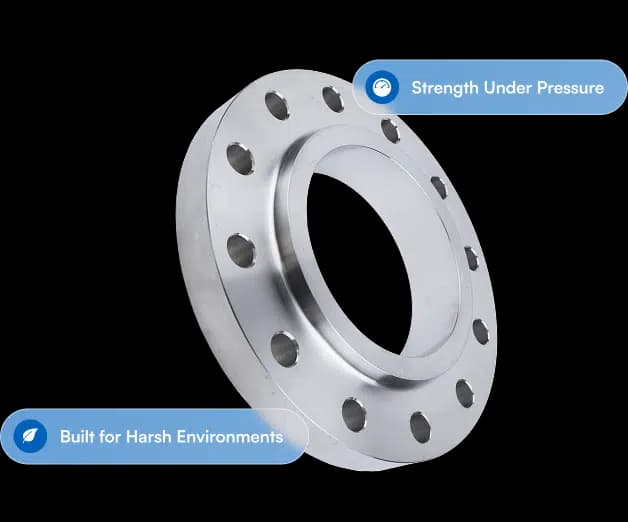
What Is a Reducing Flange?
A reducing flange is a specialized flange that accommodates two different pipe sizes in a single component. Unlike standard flanges which have a bore matching the connected pipe, reducing flanges feature a smaller bore on one end that steps down to a larger bore on the other. This design allows you to transition between different pipe sizes while maintaining a bolted connection on both ends. Reducing flanges come in various configurations including weld neck reducing flanges, slip-on reducing flanges, and threaded reducing flanges, each suited to different pressure classes and installation scenarios.
The flange itself typically has two sets of bolt hole circles with different diameters corresponding to each pipe size. This dual-circle design enables you to bolt the flange to standard flanges on both the larger and smaller pipe sides. The bore transition between sizes is smooth and can be designed to minimize turbulence depending on your application requirements.
Why Use a Reducing Flange Instead of a Reducer?
One of the primary advantages of reducing flanges is the reduction in system components and assembly time. Traditional piping systems that need to step down in diameter typically require a weld neck or slip-on flange on the larger pipe, then a separate reducing fitting (like a concentric or eccentric reducer), then another flange on the smaller pipe. This creates more potential leak points and requires additional welding or threading work. A reducing flange accomplishes the same diameter transition while eliminating the intermediate fitting entirely.
Reducing flanges also provide superior bolt connection integrity since both pipe sizes are flanged, which distributes loads more evenly across the joint. In high-vibration or high-pressure applications, this can result in more reliable performance. Additionally, reducing flanges simplify maintenance procedures because technicians only need to manage two bolt circles instead of juggling multiple fittings, making disassembly and reassembly faster and less error-prone.
How to Specify a Reducing Flange
When ordering a reducing flange, you need to provide several key specifications beyond just the name. Start by identifying the larger (primary) bore size and the smaller (secondary) bore size in inches, using standard pipe sizes like 2x1, 4x3, or 6x4. Next, specify the pressure class for each bore diameter. Often both bores are the same pressure class, but your system design might require different classes if one side operates at higher pressure than the other.
You'll also need to specify the flange type for each bore if they differ. For example, you might specify a weld neck bore on the larger side and a threaded bore on the smaller side. Material specification is critical, so select ASTM A105 for carbon steel, ASTM A182 for forged alloy steel, or ASTM A351 for cast stainless steel depending on your temperature and corrosion requirements. Finally, specify the type of bore connection: raised face (RF) is standard for most applications, but ring joint (RTJ) is used for high-pressure applications requiring more aggressive sealing.
Standard Sizes and Availability
Reducing flanges are available in most standard pipe size combinations, though the extent of stock options varies by manufacturer. Common combinations include sizes like 4x3, 6x4, 8x6, 10x8, and 12x10 inches. The ASME B16.5 standard covers reducing flanges up to 24 inches in diameter and includes pressure classes 150, 300, 600, 900, 1500, and 2500. For larger diameters above 24 inches, ASME B16.47 applies with Series A and Series B options.
Lead times and pricing for reducing flanges can vary more than standard flanges because they're often custom ordered rather than stocked. Some manufacturers maintain inventory of the most popular size combinations, but unusual transitions like 14x10 or 18x14 may require longer lead times. When planning your project timeline, it's important to verify availability early in the procurement process. If standard reducing flanges aren't suitable for your application, you may need to investigate whether a custom bored flange can be produced from a standard flange blank.
Installation Considerations
Installing reducing flanges requires careful attention to bolt alignment since you're working with two different bolt hole circles. The larger bolt circle should align with the larger pipe flange, and the smaller bolt circle with the smaller pipe flange. Some technicians make the mistake of forcing a misaligned installation, which can result in uneven bolt stress and premature gasket failure. Always verify that the bolt patterns align properly before attempting to bolt up the joint.
Gasket selection matters more with reducing flanges than with standard flanges because the bore transition can create unusual sealing surfaces. You need gaskets that accommodate both the larger and smaller bore circles appropriately. Ring-type gaskets designed for the specific bore sizes work well, but ensure your gasket supplier understands you're working with a reducing flange. Bolt torque values should be determined from the pressure class of the smaller bore size since it determines the overall system pressure rating of that particular joint.
The Bottom Line
Reducing flanges offer a clean, efficient solution for pipe size transitions in flanged systems. They're particularly valuable in congested spaces where multiple fittings would be impractical, in applications requiring high reliability, and wherever you want to minimize the number of potential leak points. The initial cost of a reducing flange may be slightly higher than purchasing separate components, but the labor savings during installation and maintenance often justify the expense. When specifying your next piping system that requires a diameter step-down, ask your flange supplier about reducing flange options. In many cases, you'll find they provide a superior solution compared to traditional multi-component approaches.